A Conversation with Two Trees (and an antique camera)
I’ve not spoken to many trees in my lifetime.
More accurately, not many trees have ever spoken to me. That’s not to say it has never happened.
If ever there was a conversation to be had with those branches and those roots and those leaves the words have always floated along on the wind, dancing and sparking on the crest of infinite thought. The sentences hidden there for all but that sacred fleeting moment, hung someplace between the shadow and the light.
The language is simple and selectively universal; interpreted for the individual mind and heart without concern for unknowing ears. My camera the soul, the lens the speaker, the voices as clear and fine as a silk violin; all vibrations leading to clear-cut understanding towards the end of some weird rainbow.
Four sheets of film. Three days. Two pictures. One conversation with the trees.
The Camera
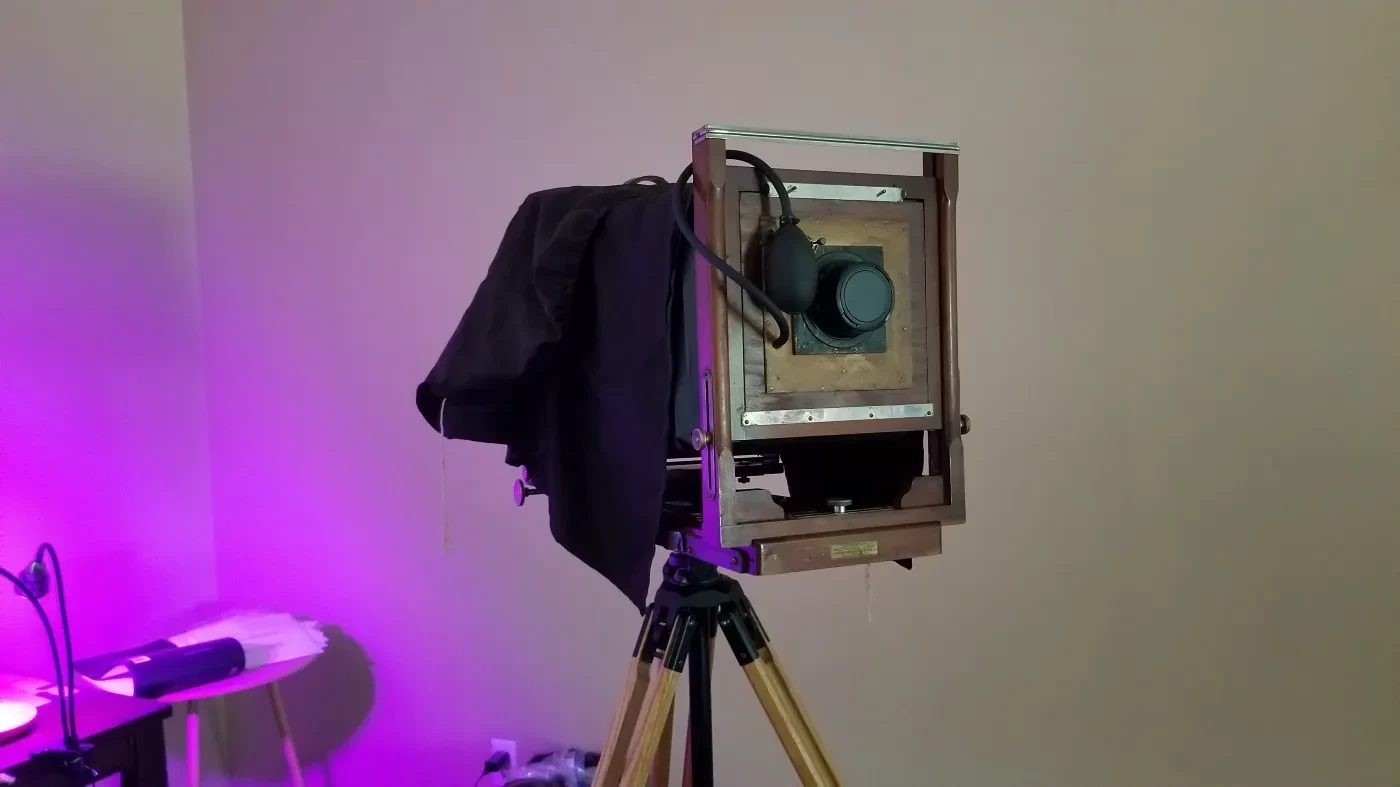
Of course, riding out to meet the trees slinging any camera other than Winston would have been obscene. “Ol’ Winston”, built no later than 1932 by the Gundlach Korona Company in Manhattan, New York. My faithful 8x10 Korona Pictorial View camera, resurrected from the ragged edge of the Great Nothingness by a chance alignment of some far-flung stars.
Roughly one year ago I stumbled upon Winston within the grim confines of a semi-local auction house. He was dying. Languishing. Suffering. Wholly and utterly neglected in the grips of his final death roll at the mercy of uncaring and adulterous hands. He will have his vengeance…or so he tells me.
Watch the resurrection of Winston here:
Restoring a 100 Year Old 8x10 Camera | FINDING WINSTON
Winston is massive. Winston is heavy. Winston travels with me now like some giant photographic boil. I love Winston.
The Lens
Selected for the day was the remarkable #34 Kodak Anastigmat 8 1/2 inch F/4.5. It’s a lens that literally shouldn’t work with the 8x10 Korona…but it does. There simply shouldn’t be enough image circle to go around for that big negative…but there is.
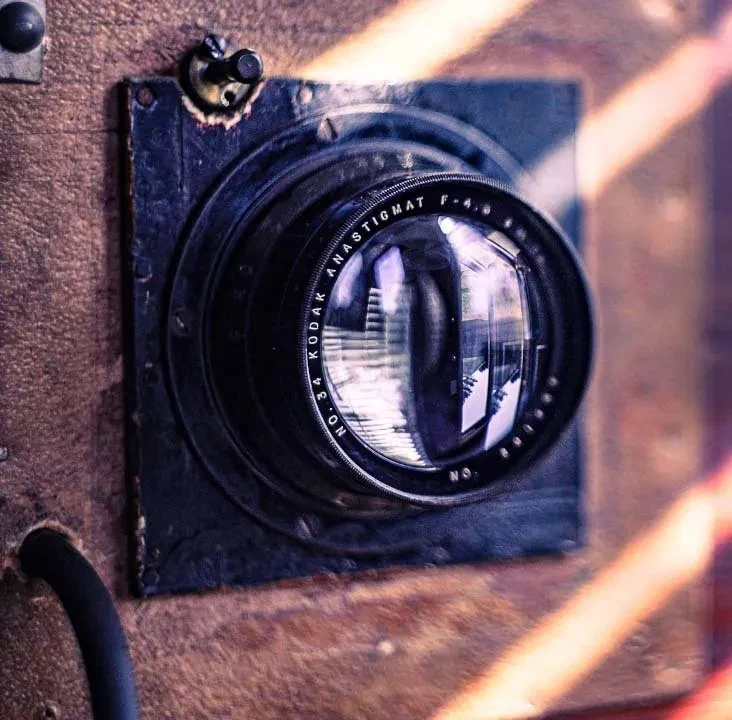
That 8 1/2 inch focal length translates to around 28mm (35mm sensor equivalent) making the Anastigmat a wide-normal/long-wide optic for the 8x10 format. It’s a brass tank of a lens with virtually zero distortion and is slightly younger than Winston having been born around 1934. The glass is beautiful and flawed, relatively fast aperture for the format, with peripheral element separation and literally air bubbles within the elements. It’s perfectly imperfect.
The Shooting
Both photographs were made along the banks of Little Swan Creek along the Natchez Trace in Tennessee. Film used for both was AGFA GS Plus radiographic metered at ISO 50.
Photo #1
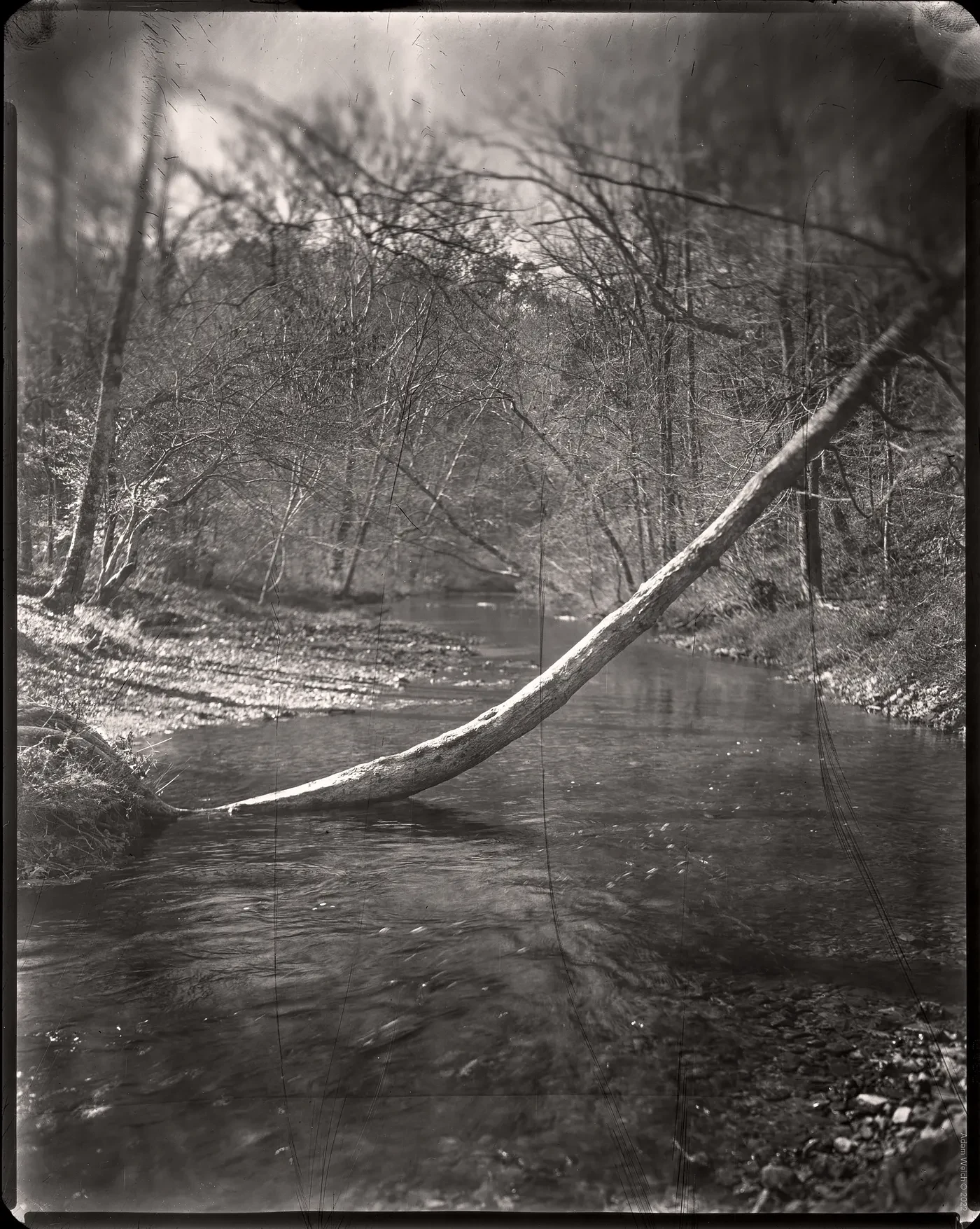
After metering for the highlights at F/5.6 and 1/60th second I set the final exposure values to F/5.6 and 1/40th second. Camera movements were sparse with only a slight front standard rise being employed.
Technical and creative considerations dictated the placing of the tree central to the frame; bisecting the composition to form a clear separation of the fore and backgrounds. I would have preferred to have captured this photograph at F/4.5 for an even more shallow field depth along with a slight rear standard swing to enlarge the left side of the frame. However, the indicated exposure time at F/4.5 was too quick for the Packard #6 shutter.
Photo #2
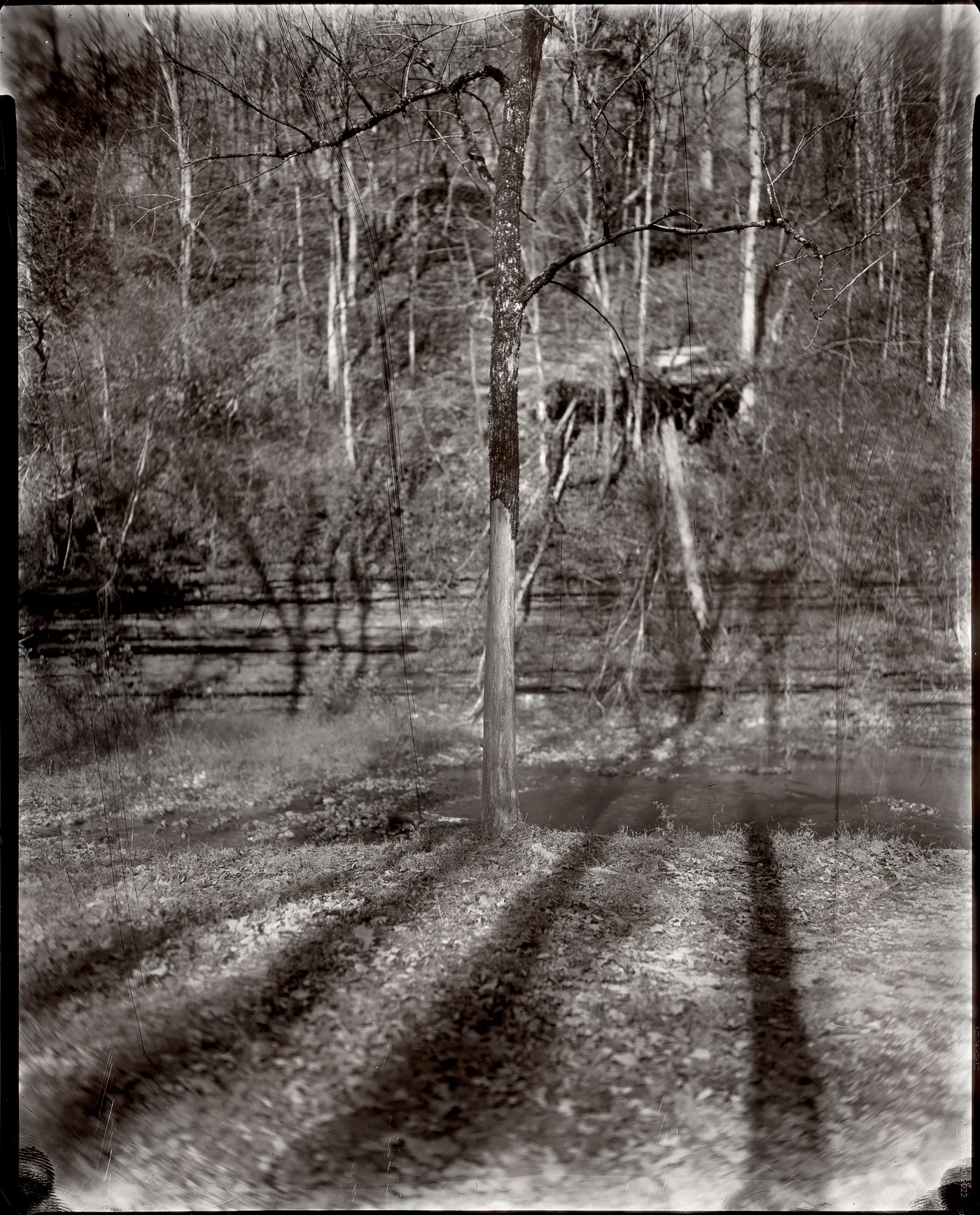
The following day I once more returned to Little Swan Creek with Winston. I had noticed an interesting array of shadows which fell on an even more interesting tree along the banks of the creek. My intention was to capture the tree with nearly identical shadows being cast by four other trees on either side; the tree itself being the only “true” tree in the frame. Another consideration was the missing bark which made the tree at center seem to glow when the light fell upon the exposed wood. It was to be an exercise in light, shadow, and symmetry.
I made note of the ideal time for the capture, metered and marked the approximate spot to setup the tripod for the next day, then returned to camp confident that I had it all figured out.
Naturally, I did not have it all figured out. You’ll notice from the photograph that the shadows no longer fell into line vertically, the sun no longer brightly illuminated the central tree, and overall the day ended with horrific failure — not that the outcome was a bad thing. Still, I regret the damnable position of the Earth had no consideration for the photograph I was attempting to produce.
The Cook
Development was carried out in camp within “The Hive”: my portable darkroom built from a converted pop-up ice fishing hut. You can watch how I built the Hive below:
THE HIVE | Building a Portable Darkroom | Print and Develop Alm
I have all but completely transitioned to self-making my own black and white chemistry in the form of caffenol; essentially a black and white film and paper developer brewed from a mixture of instant coffee, sodium carbonate (washing soda/soda ash), and ascorbic acid (vitamin C). It is one of if not the most eco-friendly, versatile, cheap, generally most fitting developers in my opinion, and I see no reason to use anything else for my black and white work. It’s noteworthy to add this particular batch of caffenol also featured a dash of Nut Brown Ale….
500ml of stock caffenol was mixed 1:1 with plain water to produce a 1000ml working solution. For this particular development I required a reduction in contrast to aid in highlight retention so I reduced the amount of ascorbic acid, which is the contrast agent for caffenol, by roughly 30%. Since I measure nothing, preferring to instead rely on the smell and viscosity of the wicked brew, this is of course only an approximation.
Scans were performed via Veronica, my EPSON V700 flatbed scanner at 1200ppi with toning and processed in Adobe Photoshop. I intend to pull a few Cyanotypes from photo #1 at some point.
End of conversation.
All text and images copyright 2023 by Adam Welch unless otherwise indicated