Death and Resurrection in the Time of Instagram
Is faking it the same as lying?
Breaking News from Carmel, California:*
Ansel Adams’ corpse rose from it’s final resting place today and strangled a prominent Instagram model to death during a photoshoot for a green tea extract company somewhere in the Santa Monica Mountains west of Malibu.
Sources say the ashes of the legendary photographic laureate spontaneously reconstituted themselves this afternoon in response to an obscure, yet to be verified incantation found carved into the original foundations of the Ahwahnee Gift Shop in Yosemite Valley:
“As the seas boil, as the blackened eye trembles, as the souls wail in the bloodied winds of Mageddo, so too will those who affront the purity of photography reap the whirlwind and despair”.
Bethsheba Roundtree of Fresno, CA, who was the first to discover the bizarre verse while vacationing in the Valley, recounted the events leading up to the extraordinary occurrence:
“I thought it was some kind of graffiti from one of them hippies until I read it off to Vernon (her husband). Then the ground started shakin’ like crazy and it made me drop my snow cone and Vernon’s pacemaker started acting up so we got back to the camper as quick as we could. Now they’ve got it all taped off and I can’t get back in to find my flip-flops.”
This report comes in the wake of the massive wave of worldwide disappearances of popular social media analog photography aficionados who’s work had recently been called into question for “not really being film”.
An international think tank of Hasselblad historians headed by the chairman of the Duluth Camera Club has convened in Stockholm to determine the connection, if any, these events might share.
More on this story as it develops.
— Official FPNA report**
Strange Times
A question is posed. Whether this question is consciously acknowledged by the mainstream photographic community (if there is such a thing) the reality lingers that there is indeed a certain fraction within the greater whole of popular photography that, for one demented reason or another, has found it beneficial to replicate, fake, bamboozle, hoodwink, and otherwise pull the wool over the eyes of those who truly do aspire to perpetuate the weird and slimy adoration of film and non-digital photographic practices.
We’ve entered a weird sort of dimension when it comes to the idea of what photography is, what it’s worth, and why any of us should give a damn.
Does the way we make a photograph matter? Does the camera matter? The lens? In the light of some recent revelations, apparently it does.
These revelations did not come about over the quiche brunch in the Admiral's Room at some pretentious gallery in some stuffy art district where one might be forgiven for thinking that “the method matters”. In those situations, there is, for better or worse, a certain greasy pedigree which must be lived up to in order for the “work” to be considered “the work” and not just pictures. Prices to match.
All of that’s beside the point. The strangeness I’m referring to is pitched so meaningless at face value that one struggles to wrap their minds around the idea that someone might go through the trouble of even perpetrating it at all.
My attention first peaked when I happened to notice some images posted on a photographer’s account I used to follow on Instagram. Beautiful photographs captured in both film and digital mediums.
Lots of photos of them making pictures with their film cameras — tens of thousands of followers — recognized throughout the photographic community as a credible and competent professional. In other words, a photo maker admired by many.
Then, like a bolt blasted down from the Gods, my eyes snagged onto something that felt “off”…”spurious”… possibly even “askew”. Some might go as far as to call it “a bit fucky”.
Many of the “film photos” which appear as full-frame scans complete with frame borders included (you know the kind) seemed to have repeating, identical frame numbers.
What was this? Was I wrong? After looking through the feed of the photographer, who will remain nameless for reasons I can’t determine — but let’s just call them Crett Burry — I noticed more and more repeating frames housing many different photos. There were even double exposures, stated as being captured on film, which were also sporting these same duplicated borders.
Ye God’s! Is someone not being totally transparent about their photographs on social media? Woopdido. Shocking, I know.
So what, right? 99.99987% of the time this sort of sad occurrence would slide right under my shoes without a care. Believe it or not, as much as this random bit of lofty-minded prose might cause the gentle reader to believe that I’m some sort of artistic whistleblower or weeping photographic martyr. I honestly couldn’t give two damns what other people do with their picture or anything else for that matter.
Oh but then…dear reader…but then… I began sifting through the comments on said photos; glowing and extolling comments from Instagrammers praising the film work and prowess of capture. Comments from aspiring non-digital shooters expressing how they wished their film photographs could look this good; lamenting in shame how they know they could never reach this level of perfection.
Questions where repeatedly asked about the processes used, the cameras and the lens…AND GETTING ANSWERS.
Now, here’s where the waters truly surge turgid. Was I correct in my perceived assumption that these so-called film images could possibly be, well, not? Was I wrong? Had my perceptions been dulled through years of… nevermind. These were all valid concerns then just as they continue to be now.
In an effort to confirm my suspicions, I broached several other fellow film photographers who I respect, and whose collective technical opinions are as good as Gospel. I presented them the images in question, separately asking each of them only if they noticed anything “odd”.
Without fail, virtually all of them immediately pointed out the same repeating frame numbers as I had noticed. Some went as far as to question certain technical points about a few of the images which I hadn’t even noticed. To my surprise, a few of them even relayed instances of other photographers, some quite- well known, in whose feeds they also happened to notice certain “irregularities".
So, it turned out I wasn’t actually crazy. Well, let’s not go that far. At the very least I was now assured that what I thought I was seeing truly was an anomaly.
I couldn’t help but think of myself. That’s right. Me. Selfish I know…but not myself in the present tense; the younger me, the more handsome me, the me who I saw reflected in the commenters extolling these brilliant photos which could now at least be questioned in their analog veracity.
I sensed the fading glow of hope in the dwindling enthusiasm expressed as they graded their own film photography to be less important because it didn’t meet what they now gathered to be the true potential of the medium. This was wrong. I care nothing about Crett Burry. Them, they’re work, what cameras they use or don’t use. I. Do. Not. Care.
“You do you.” is the mantra sung throughout my dank and lurid halls. Hell, I’m even somewhat of a militantly unpretentious film addict. I happen to believe there is no true “film look” especially in the realm of digital scanning and printing of negatives (and positives). There are just too many variables, too many ways to manipulate things. Time, temperature, stock ages and paper, viewing light, chemical exhaustion; it all changes how the final cake is baked.
It’s crucial to communicate this aspect of my gripe as accurately as possible because it’s important for me to know that you know that I know you know this issue is not one person’s obtuse opinion on how things should be done. No no, my reasons lie in taking a firm stance against the gross indifference of creative profiteering.
Photography has no inherent worth until we place worth upon it via emotional attachment and motivation. In the same vein, a feeling of inadequateness stirs in the mind of aspiring picture makers when they view work from other photographers, who they respect, without realizing that work has potentially been misrepresented.
It’s the photographic equivalent of the Barbie Doll. It portrays an unrealistic idea of what can be achieved through film photography, or, at the very least, does not truthfully represent the full measure of its merit.
A Point Missed
What’s to be done? Well, not much; not in the grand scheme. However, for me, in this singular situation, I decided to take the bucket directly to the source.
Let the person speak for themselves. Who knows? After all this I might still be wrong about the entire thing. Give the photographer a chance to confirm if what I had noticed was indeed correct and, if I was correct, offer any thoughts as to why they chose to present their work in such a questionable fashion. So, I sent a message on Instagram. I received an immediate, courteous and polite response.
Spoiler alert…I wasn’t wrong. You’re welcome to drink in the entire conversation between myself and this photographer (with accompanying commentary) below:
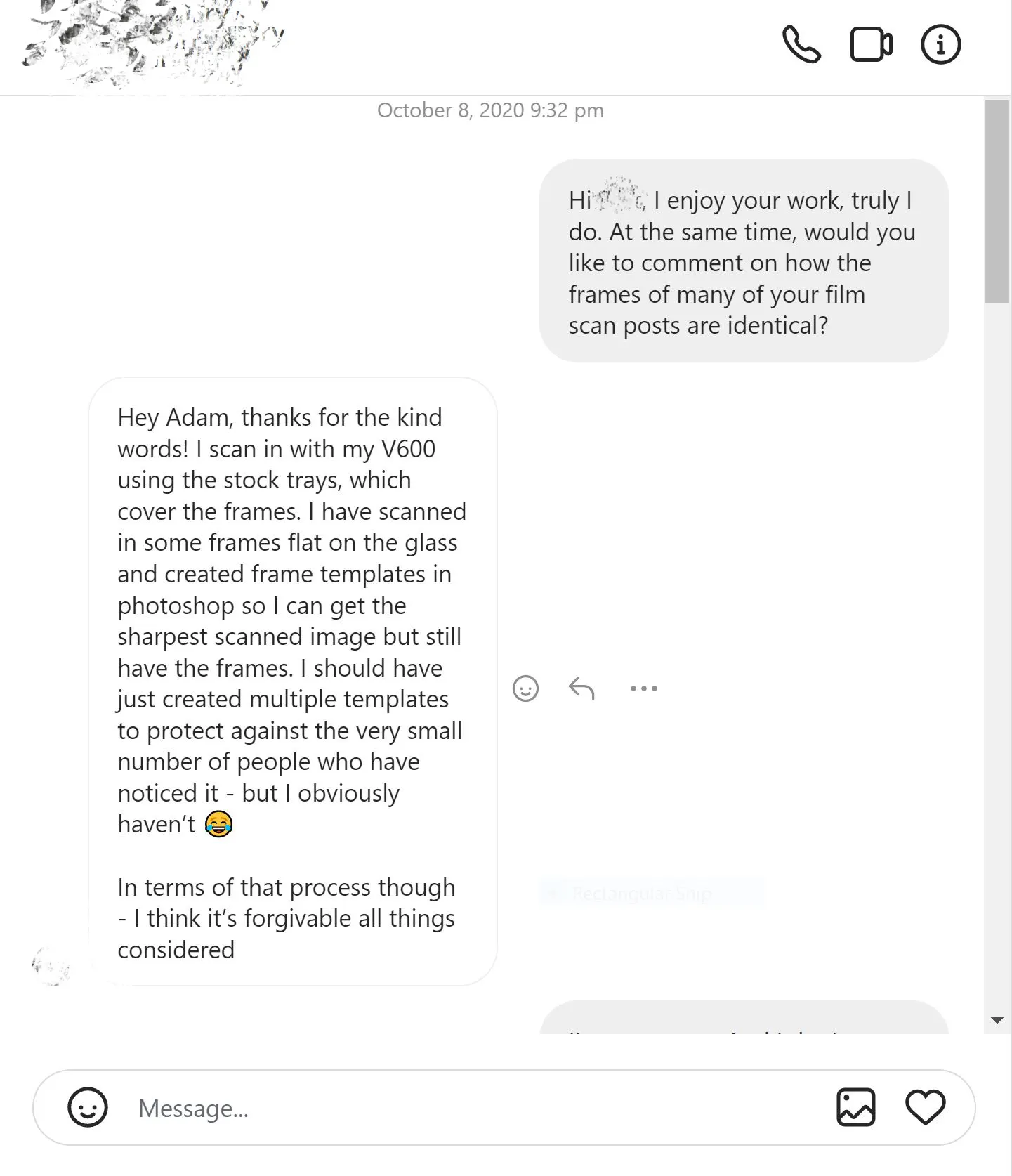
As you can read, the person confirmed that the film frames were indeed added to the images in Photoshop from what are their own templates which have been scanned previously.
The explanation was that this is done to achieve the “…sharpest scanned image but still have the frames.” After a bit of discussion, I brought up the possibility that…let’s just call it what it is…the possibility that the images could have been made with a digital camera and not a film camera with the frames added just as easily during post- processing.
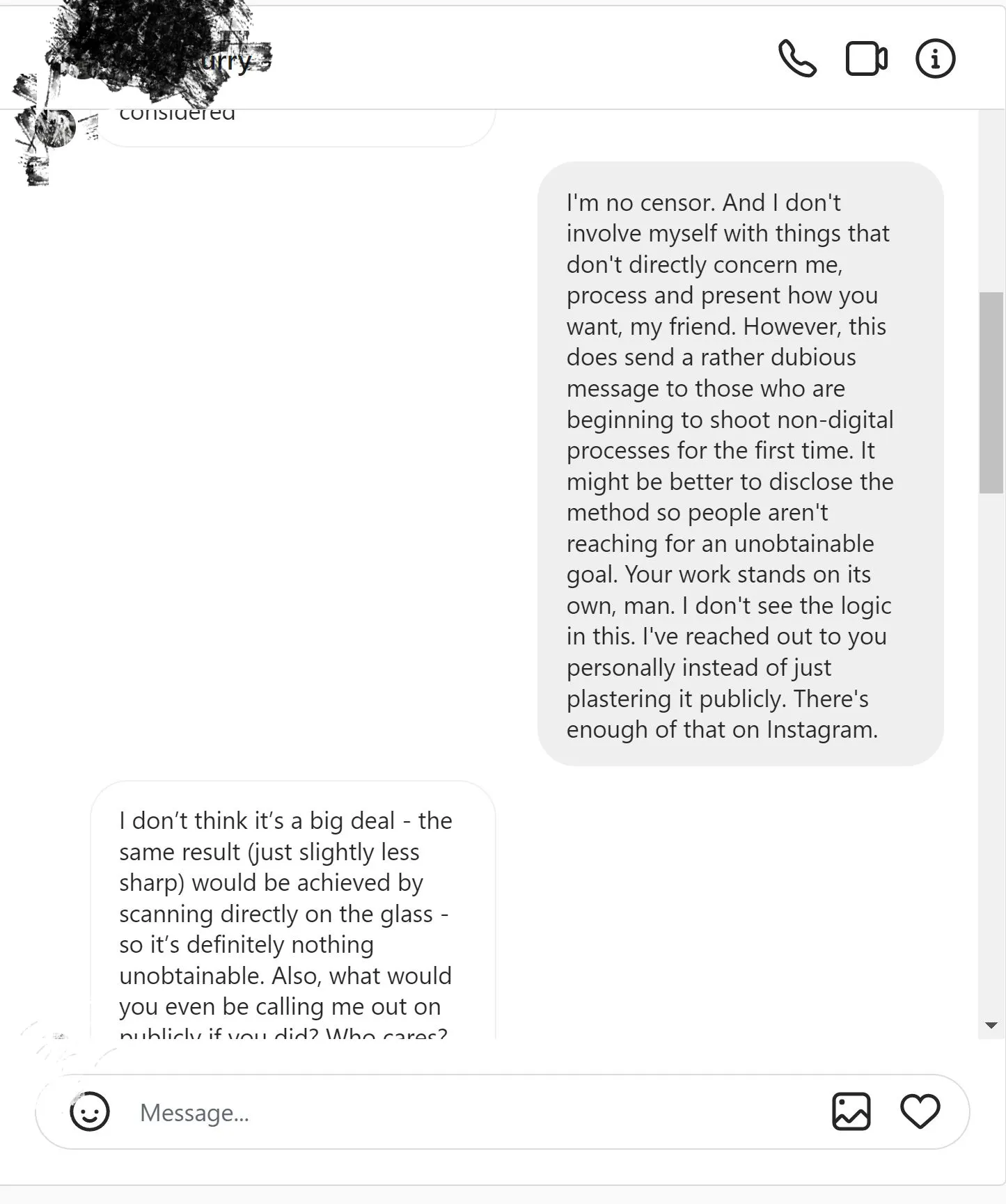
I was then assured that the photos were absolutely made on the film stocks indicated by the template frames which had admittedly been digitally inserted onto images in Photoshop.
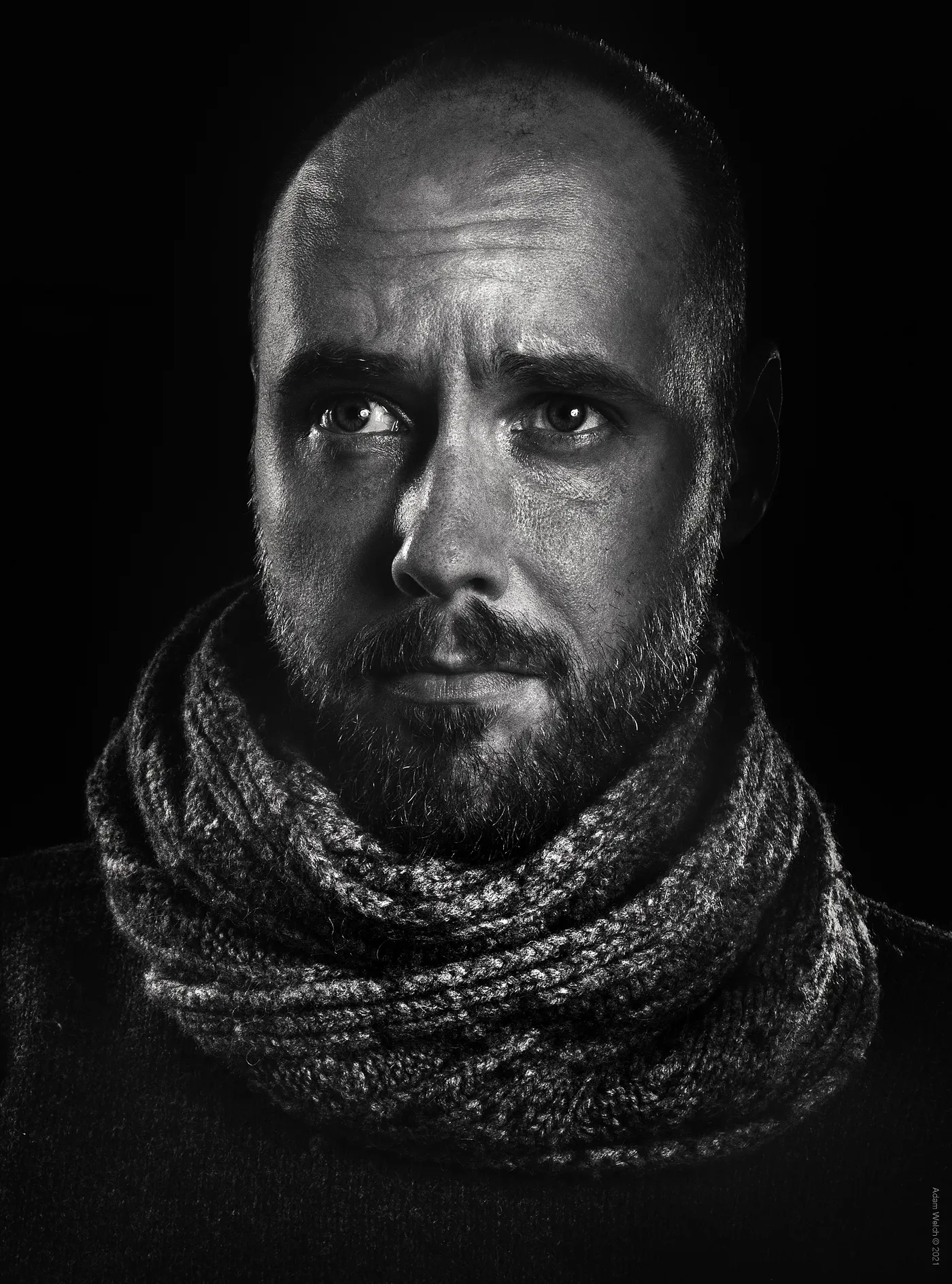
A self-portrait of the author; ripped off from my favorite portrait of Ernest Hemingway by the estimable Yousuf Karsh. Shamelessly included postscript to serve as a featured image for this story.
End of conversation.
The hard-snorting bit of dialog came from when I mentioned the possible implications of how budding film photographers might potentially envision these works as an impossibly unattainable goal when taken out of context. I received the following response:
“I explained why I do it and why it isn’t a big deal. It’s not my responsibility to represent anything any particular way — I’m just taking pictures and posting them on Instagram.”
And you know what? They’re right. It’s not their responsibility to represent their pictures in any way other than how they choose. Honestly, a cordial interaction given the nature of the conversation.
This photographer received an awkward question and they answered it; that’s all that can be expected from anyone. Still, the answers I received left me a bit befuddled.
Resurrection
The issue has never been about dictating how photographers should present their photographs. This is social media, Instagram no less; the scrollable cesspool where creative expression goes to die. Instead, it’s a question of humanistic ethicality. In a perfect world, this inherent ethicality should transcend any and all platforms.
Answering questions about how a film photograph was made yet somehow omitting the fact that it has, at the very least, been presented with a digitally inserted film frame border does not breed a well lit personage for anyone. After learning that this is far from an isolated occurrence I’m left even more depressed and confused about the landscape being cultivated for the future of photography.
Has it ever been enough to just make a photograph which people enjoyed to look at on a wall, on a screen, in a book? Has there always been an undercurrent of propriety and right direction that should be taken to reach an ultimate end? No matter the answer, there is admittedly an odd breeze blowing through the photographic trees of today. So-called “antiquated” photographic practices are being leveraged to lend…to lend…to lend what? Professional credibility? Technical admiration? I sit in perplexed wonderment about these things.
Is photography dead? Have we killed it? These are heavy questions to ponder.
It seems as if every generation of camera artists has faced similar existential meat grinders. The realists hated the pictorialists. Color film was seen as “unprofessional”. Digital cameras were for children. No “pro” would ever shoot anything smaller than medium format.
Now, gentle reader, you and I find ourselves talking about whether it matters if a digitized non-digital image is being passed off as a film photo on a commercialized picture sharing application.
And to think, the future was looking so bright.
*This news story, of course, is a complete work of fiction. **Fake Photography News Association.