The Beautiful Tragic Life of George Masa
Resurrecting the memory of a forgotten giant
Loading reader…
Voices depend on your device. Recommended favors British English when available. Drag the slider to jump to a passage. Highlighting follows the current passage, and individual words when supported by your voice. Image credits and references are skipped.
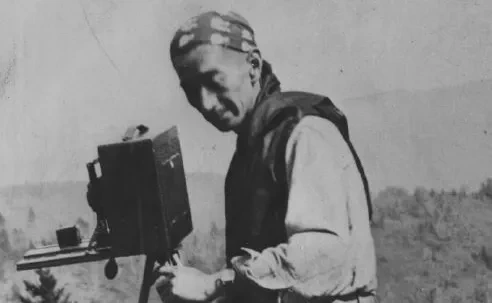
Beneath the shaded Oak groves of a small cemetery outside Asheville, North Carolina rests the grave of a man who history nearly forgot.
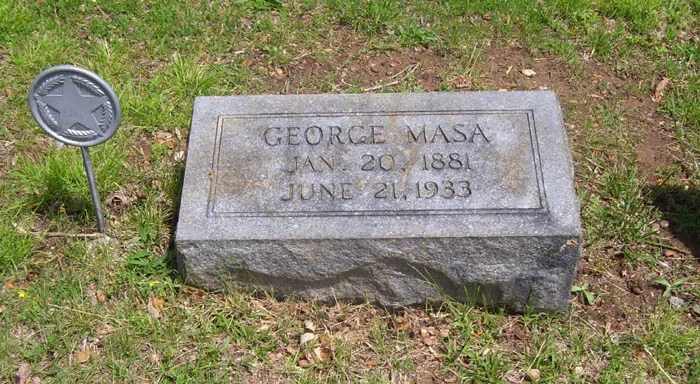
The headstone is simple, no fanciful carvings or effigies signifying the incredible life led by the one interred.
In lot 95, Grave 25 of the Old Y section of Riverside Cemetery, you can find a faded granite stone telling the dates when a man made his worldly entrance and final exit.
With the dates comes a name, and the name is George Masa.
Masa’s life had no happy ending. No triumphant send off fitting the stature of the unlikely hero considered by many to be the Ansel Adams of the Smokies.
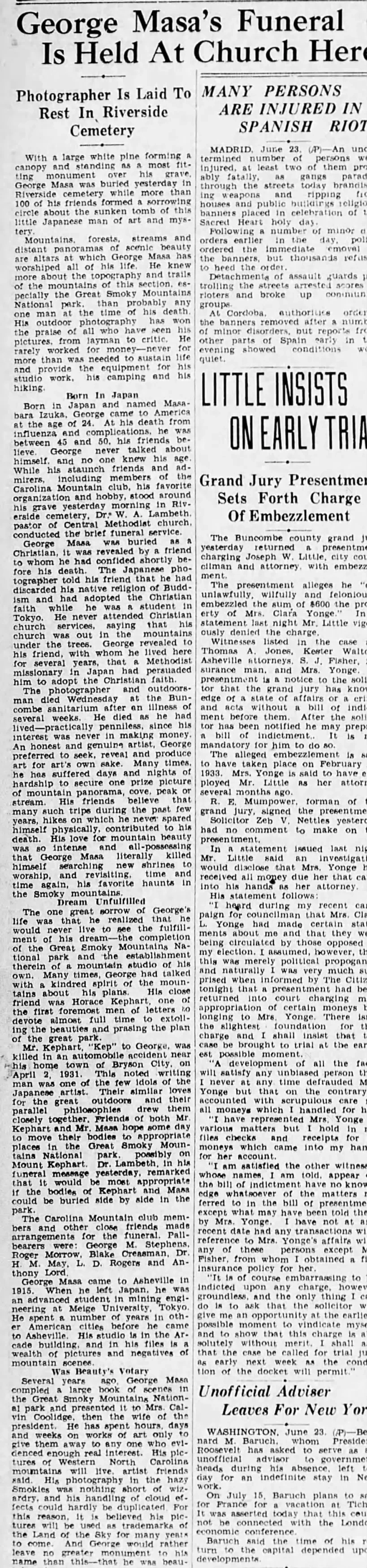
Instead, he would die penniless on a Wednesday, alone in one of those steel frame bunks of Buncombe County sanitarium. The Saturday edition of the Asheville Citizen-Times would print a single column eulogy, eloquent and sympathetic, but at the time falling short of a lasting tribute for such a giant.
The beginnings of George Masa are laced with contradictions and the waters surrounding his origins are murky at best. Any particulars regarding his early life remain nearly impossible to verify due to the dilution of time and lack of hard copy records.
However, we do have at least some ideas based on his own letters and journals, personal accounts relayed by contemporaries, and from information found on his official certificate of death. As we’ll see later, even these seemingly reliable sources still manage to cast a long shadow of mystery.
But all stories have to start somewhere, and for the man who would come to be known as George Masa, the story begins in Osaka.
George Masa tells us he was born in Osaka, Japan on January 20th, 1881. Connections to his early life in Japan remain elusive aside from a few tantalizing clues strewn along the way. The original spelling of Masa’s name is even up for debate as it is presented with multiple variations throughout the course of his life.
For our purposes, I choose to move forward with the spelling found on this 1932 print from Masa’s former photo studio: Masahara Iizuka.
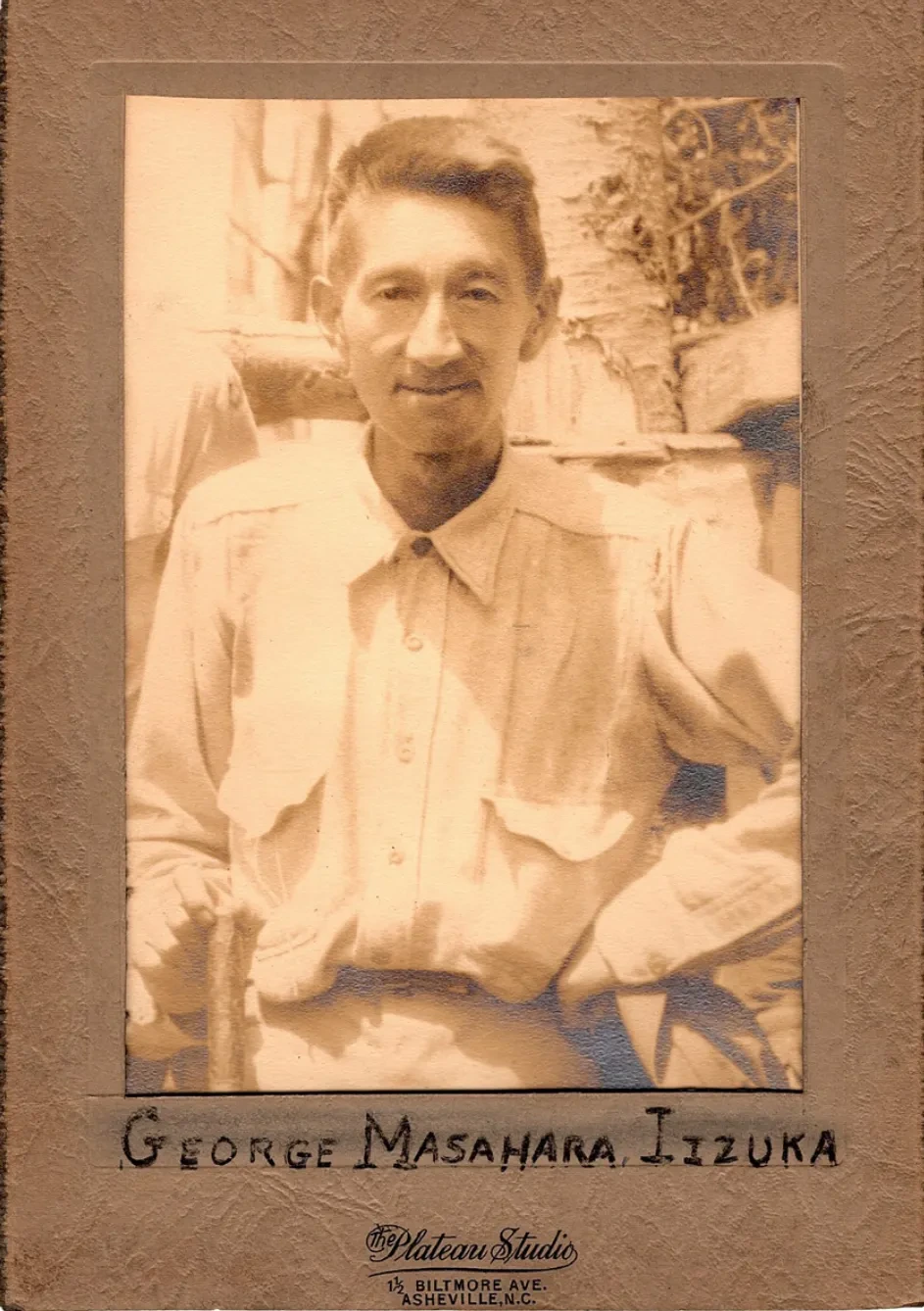
To this day, there remains some confusion as to the correct spelling of George Masa’s original name, when he chose to change it, and why.
You can find his name as Masabaru Iizuka, Masaharu Izuka, Massaharu Izuka, and Massabara Izuka, with at least one account naming him as “Izuka George” following the East-Asian cultural tradition of placing one’s family surname before the given name.
By his own account, Masa left Osaka to study mining engineering at Meiji University in Tokyo. While there, he met a Methodist missionary and converted his religion from Buddhism to Christianity. Shortly after this encounter, Masa would be compelled to head west by east, taking the Pacific passage to the United States. It is here where we slowly begin to understand the events that would shape the remainder of his life.
In 1906, at the age of 25, Masa would land in San Francisco, California allegedly as a stow away on a ship from Japan. There is no official record of the specifics surrounding this event. However, if Masa had illegally entered the United States there likely would be no immigration records available.
Following his initial arrival in the United States hard evidence of at least some of Masa’s travels surface beginning with the 1920 and 1930 US Census. He remained in San Francisco (for at least a while) and enrolled at the University of California, continuing the mining engineering studies he began in Japan.
For unknown reasons, Masa abandoned his studies in California and headed east by train. Researchers state that he briefly resided in both St. Louis, Missouri and New Orleans, Louisiana. While in New Orleans, Masa sought out the services of an employment agency. The agency directed him to a booming mountain town in western North Carolina.
On July 10, 1915, he at last arrived in Asheville along with a group of his “Austrian friends” (or a group of “Japanese students” depending on the source) to begin work in the laundry of the luxurious Grove Park Inn. This postcard shows how the inn would have appeared at the time of Masa’s arrival. The Grove Park Inn is still operational today (2024).
It was at Grove Park that the man born Masahara Iizuka would adopt his lasting moniker: George Masa. This final name change was likely done in an attempt to be more pronounceratorial to the Western palate, or as Masa simply said, “for convenience.”
Whatever the case might have been, by all accounts the election to condense his name was made by Masa himself.
Masa worked through the proverbial ranks at the 150 room Grove Park Inn from the laundry, to bellhop, and finally valet — parking the cars of the affluent visitors to Grove Park.
It’s unclear exactly when Masa first picked up a camera. It’s said that the designer and manager of the Grove Park Inn, Fred Seely Sr., loaned George his camera in order to make photos of the guests and property for promotions, leading to Masa becoming well-known and well-liked amongst the inn’s visitors (many quite wealthy). One might be forgiven for assuming this was the beginning of Masa’s career as a photographer, but the path of his life would once again lead him west.
At an unknown point in 1917, Masa suddenly chose to leave the rolling green valleys of Asheville for the snow capped summits of the Rocky Mountains in search of gold. He prospected in and around the area of Colorado Springs, Colorado for two years — finding nothing — at least nothing to hold him in Colorado.
He returned to Asheville in 1919, temporarily renewing his work at the Grove Park Inn with the stipulation that, according to a letter sent to Seely, he wanted any job EXCEPT valet. However, his return to work at Grove Park would be short lived and in February of that same year Masa partnered with notable Asheville photographer Herbert Pelton. Together, Masa and Pelton formed The Photo Craft studio in the Morsell building at the heart of bustling downtown Asheville.
So began Masa’s nearly two-decades of photographing the people, landscapes, and events taking place around him in the southern Appalachian Mountains.
By December 1919, Masa decided it was time to go into business for himself, creating his own photography company, Plateau Studios. During this time, he also worked as a cameraman for Asheville-Biltmore Film Company recording moving pictures for Paramount Studios and Plathe’ News (the latter being a UK-based news agency).
To date, none of Masa’s cinematic work has been located aside from a single reel recorded in the early 1930’s, which was featured at approximately 34:12 in Paul Bonesteel’s documentary The Mystery of George Masa.
After selling Plateau Studios to Ewart M. Ball (another Asheville photographer) in 1924, Masa continued with his success as a commercial photographer and cinematographer. So much so that he opened yet another photography studio, the Asheville Photo Company, in 1925.
The years following the creation of his second photography company would prove pivotal for Masahara Iizuka, the 5 foot 2 inch, 100lb immigrant from Japan. Little did he know, but he was on a direct course to a meeting with destiny; a meeting that would ignite the photographic legacy of George Masa.
During the mid-1920’s large-scale unregulated logging was gutting the forests of the Appalachians. Despite measures put forward by the Weeks Act of 1911, rampant clear-cutting of the virgin timber lands was still wreaking devastating havoc on the fragile mountain ecosystems.
From northern Georgia across the Blue Ridge along the border of Tennessee and North Carolina, all the way to east Kentucky, southern Virginia and beyond, the scalping of land led to massive soil erosion, contamination of waterways, and literal poisoning of the native wildlife.
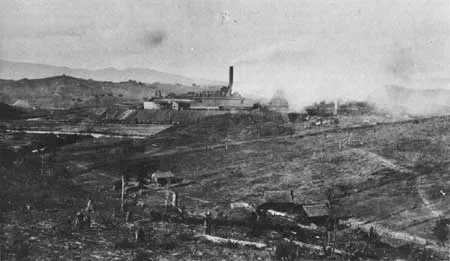
Mining and timber interests acquired massive swathes of acreage to carry out excavations and lumber extractions on an industrial level. The William Ritter Lumber Co. out of West Virginia, the largest lumber company to exist in the Appalachians at the time, held ownership of nearly 200,000 acres in North Carolina alone.
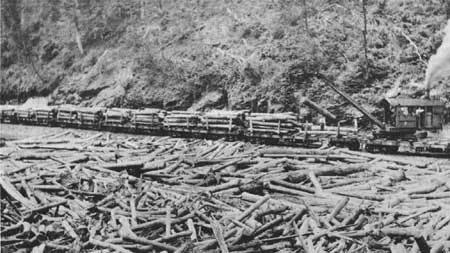
The horrific impact of these increasingly prevalent mining and logging operations began drawing national attention from many notable conservancy groups and environmental lobbyists. Perhaps the most notable, and ultimately one of the most influential figures to enter the Appalachians during this time was ex-Yale librarian turned naturalist and author, Horace Kephart.
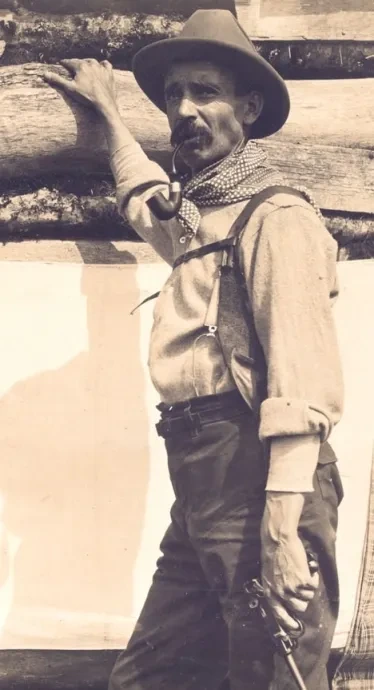
Kephart had ventured to the mountains from St. Louis following a struggle with depression and alcohol, seeking self-redemption of both mind and body. He wrote prolifically about his experiences living in an abandoned cabin on the Sugar Fork of Hazel Creek, north of the area that would later become Fontana Lake.
Perhaps his most well-known (and mildly controversial) bit of prose was the book Our Southern Highlanders which documented the peoples and places of rural southern Appalachia. The book is counted among one of the first widely published accounts of the area’s culture, although it has been moderately criticized by some who feel it painted less than a balanced picture of the general population in the southern Appalachian Mountains.
Kephart felt a personal responsibility to protect the lands he believed quite literally saved his life. He campaigned to bring the massive environmental toll of the mining and logging firms to the attention of not only the United States Government, but to the wealthy and affluent, many of whom held vested (possibly self-interested) stakes in the long term survival of the region’s natural landscape.
Unfortunately, words could only do so much. To fully illustrate the implicative subtleties of the matter for an article he was penning, Kephart knew he would need photographs — many, many photographs.
There just so happened to be a well-known and well-liked photographer in the area who was already making the exact type of photographs Kephart knew were needed.
The meeting of Horace Kephart and George Masa proved to be one of the most monumental events in the history of North American environmental conservancy. Two men cut from the same cloth brought together from across the globe through a series of incredibly unlikely circumstances. The two became nearly inseparable friends, a facet which would eventually end in tragedy for Masa.
Throughout the mid to late 1920’s Masa and Kephart would work together documenting the trails and landscapes within the southern Appalachian Mountains. Kephart with his words and Masa with his photographs, the two invested their talents in an effort to harness national support for the protection of the southern Appalachians. These photographs, virtually all exposed using either 8x10 or 5x7 large format cameras, brought a depth of realism that was second to none.
The stamina and dedication possessed by Masa to accomplish this level of photographic achievement boggles the mind even today, especially considering that many of Masa’s photographs consisted of bromide dry plate glass negatives.
As a large format and ultra large format photographer myself, the logistics of carrying such a camera outfit for days and weeks at a time, let alone into the remote areas where Masa made his photographs, would be an exercise in controlled torture. I have personally used my restored Korona 8X10 Pictorial View camera in some of the same places as Masa. The experience was humbling.
Kephart said Masa liked to photograph “terra incognita”, unknown ground. This led to Masa also playing a crucial role in the cartography of the southern Appalachian Mountains in addition to his prolific photographic contributions.
He was largely responsible for the mapping of what would eventually be designated as the entire North Carolina section of the Appalachian Trail, later becoming a founding member of the Carolina Appalachian Trail Club.
Masa constructed a self-designed odometer from the front end of a bicycle. He could be seen piloting his contraption on the mountain trails at great speed, much to the dismay of fellow hikers not used to seeing a small Japanese man pushing half a bicycle around the wilderness of Appalachia.
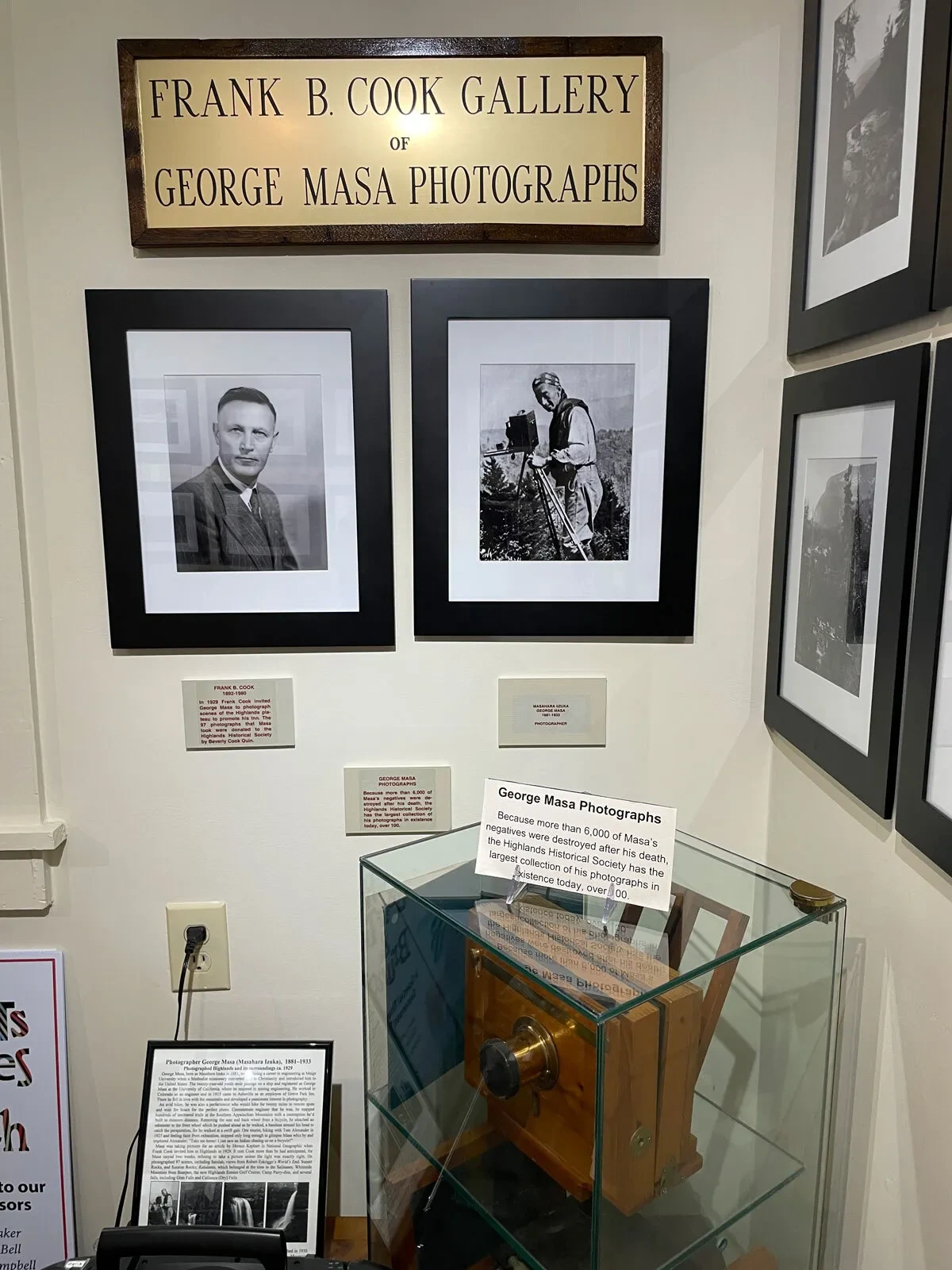
During the time Masa was working with Horace Kephart he would be invited by Frank B. Cook to Highlands, North Carolina in 1929. Cook requested Masa come stay at his Highlands House hotel to take pictures in exchange for room and board, meals — all expenses compensated. As the owner of the hotel, Cook hoped the photographs would help drum up interest for his struggling business.
Masa was originally meant to stay at Highlands House only for a few days but his residency ultimately stretched to over two weeks. In the end, Masa would produce no less than 97 photographs which are now housed in the Frank B. Cook Gallery. These photographs are now the largest known collection of George Masa’s photographic works in existence today — a surprising revelation seeing as Masa was in possession of roughly 6,000 photographic negatives at the time of his death in 1933.
This is perhaps one of the greatest tragedies surrounding the life and work of George Masa. The questionable events orbiting the disappearance of Masa’s enormous body of work is something we will revisit a bit later in his story.
The inherent need for an environmental safety blanket of Federal protection was all but blindly obvious. Through the lobbying spearheaded by Kephart, and bolstered by the visual support of Masa’s photographs, momentum was building towards the creation of a National Park to forever conserve the natural splendor of the southern Appalachian Mountains.*
In bills signed in 1925 and 1926, United States President Calvin Coolidge had sanctioned the development of a National Park in the southern Appalachians. However, the fact remained that the endangered lands were still very much legally owned by the logging and mining industries responsible for their continued destruction.
Before any type of real movement could occur, those lands must be secured for governmental consideration. To that end, the proponents of the idea for a National Park designation for the great swathe of the mountains in east Tennessee and western North Carolina needed one thing: money.
Lots of money.
So, so much money.
Masa became somewhat of the unofficial public face of the National Park movement in North Carolina. He repeatedly sent photographic portfolios to the Governor of Tennessee and North Carolina in an effort to persuade them to allocate State funds for the project.
It is purported that Masa also personally sent a book of his photographs to First Lady Grace Coolidge, wife of then U.S. President Calvin Coolidge, to bring greater publicity to the effort.
Arno Cammerer, assistant Director of the National Parks Service and later it’s 3rd Director, reportedly presented a briefcase full of photographs (many by Masa) of the “Big Smokies” to John D. Rockefeller Jr., who was said to have known Masa from his time at the Grove Park Inn.
Along with the impassioned pleas made by Cammerer, the photographs purportedly led to Rockefeller’s donation of $5 million towards the National Park cause in honor of his mother, Laura Spelman Rockefeller, in 1928. This was an astronomical sum at the time and a dollar for dollar match of the funds put forth by the State of North Carolina and other donors. In the end, that which Masa had spent nearly a decade laboring to create was finally achieved.
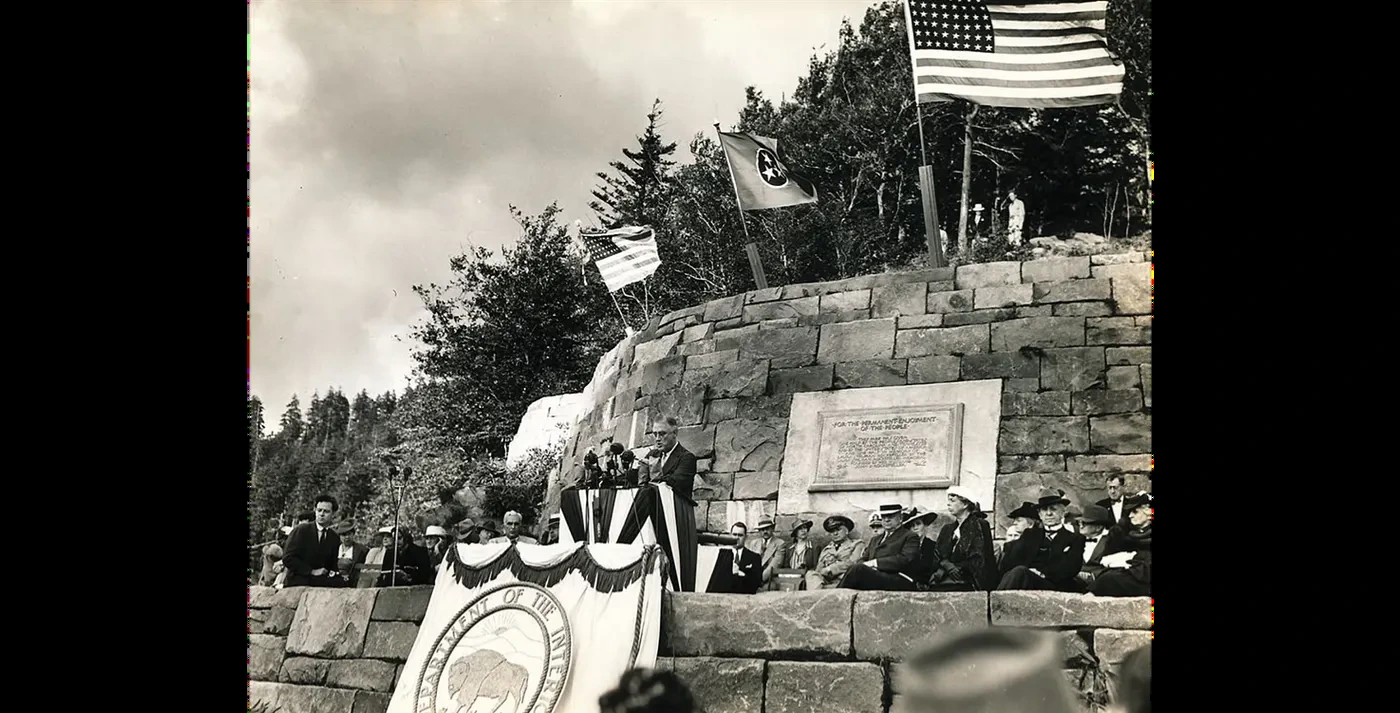
Great Smoky Mountains National Park was legally formed on June 15th, 1934 and officially dedicated by President Franklin D. Roosevelt on September 2nd, 1940.
Neither George Masa or Horace Kephart would live long enough to see the fruits of their labor come to fruition. Much like their experiences in the mountains, the final days of both Masa and Kephart would be closely interwoven, if only by tragedy and grief.
The date is October 29th, 1929. History would come to know it as “Black Tuesday.” It was the day the seemingly unstoppable financial boom of the roaring twenties came to a screeching halt.
Fortunes disappeared, lives were shattered, jobs vanished, and the immortal foundations of the United States economy felt a very human chill. It wasn’t long before the Great Depression fell upon Asheville.
In a letter to his close friend Margaret Gooch, Masa wrote the following:
“Banks closed their doors. I never saw such excited people in my life. I lost every cent I had in American National Bank, so that’s that. But my head is up. Never surrender.”
There was no escape from the financial crisis that was sweeping the nation. For Masa, who was already operating within hair-thin margins due to his work on the National Park movement and Appalachian Trail initiative, the Depression would leave him virtually penniless and in debt.
He struggled to keep both himself and his business afloat while continuing his support for the efforts being put forward to finally fulfill the dream of a National Park in the southern Appalachians. He watched as many of Asheville’s pillars of commerce succumb to the economic crash. Those who were once reliable patrons of his work no longer possessed the resources to continue their support.
Commercial photography contracts dried up. Even some of Masa’s friends chose to end their lives under the strain of the mounting pressures of the times.
Despite all this, Masa told very few people of his financial struggles. Even while he was slowly falling further and further into debt, he continued to assist those involved in the National Park effort by providing photographic prints and mapping services, very often free of charge as one of his letters reveals:
“Now listen, I don’t want you pay these as you know I am very glad to cooperate any way Park officials and cheerfully do my share what ever it comes my part so count on me, any thing you want just drop me a line that’s all. Money doesn’t mean anything for this.”
As Masa continued to struggle through the Great Depression, he received news so devastating that many close to him believe it was a leading contributor to his death.
Late on the night of April 2nd, 1931, Horace Kephart died in a car accident while returning back to his home in Bryson City from Cherokee, NC. Along with fellow writer Fiswoode Tarleton, Kephart had hired a taxi to shuttle them to Cherokee for a batch of moonshine. They shared (allegedly) their liquor with the driver, leading to the vehicle careening from the mountain road and flipping three times. Kephart and Tarleton died instantly.
R.P. Brown, the driver of the taxi, was severely injured but ultimately survived the crash. He would later claim the bright headlights of an oncoming car were responsible for causing him to lose control of the vehicle. Although a warrant was issued for his arrest while in hospital, I can find no records of criminal charges being filed against Brown for his involvement in the accident.
The news of his good friend’s demise broke Masa’s heart. Some say he never fully recovered from the impact of Kephart’s death and the loss took a toll on him both physically and emotionally.
He again wrote to Margaret Gooch on the day he learned Kephart had perished:
“I don’t know what to say about the death of our Kephart, it shocked me to pieces. This morning I have read paper, in headline, Horace Kephart Killed. I couldn’t believe it. I never experienced such a feeling in my life.”
Friends believed that the death of Kephart, combined with the cumulative effects from his years of extreme physical exertion photographing in the mountains, ultimately led to the illness that would soon claim his life.
Masa, along with about 100 other hikers, took part in the second annual memorial hike to the summit of Mount Kephart on April 2nd, 1933. The hike to the peak named in honor of his late friend had been organized by Masa the year prior to mark the anniversary of Kephart’s death. This hike would prove to be one of if not the last adventures into the mountains for George Masa.
In late May or early June of 1933, a bulletin for the Carolina Mountain Club made mention that Masa had come down with “Old Man Flu”.
The message was painted with lighthearted optimism for a full recovery. Unfortunately, this was not to be, as a later CMC bulletin related with palpable foreboding.
“Mr. Masa’s condition is still serious, although the latest word is that he is holding his own. We miss you, George, and send greetings.”
As his condition continued to deteriorate, it was as if Masa could sense his own impending mortality. In the days leading up to his death he sent for one of his friends who had accompanied him on many hikes, Barbara Ambler Thorne, to come to his bedside. Masa said that he had “something important to tell her.” For reasons that will remain elusive, Thorne was not able to visit her friend in time. Shortly after noon on June 21st, 1933, George Masa passed from this world. The official cause of death was complications from influenza. He died with no money, in debt, and with little knowledge of how his life would go on to be remembered.
It’s said his funeral drew a congregation of no less than 100 mourners who gathered at Riverside Cemetary to pay their respects to the man who had given so much to the community he chose to call home. The Carolina Mountain Club paid for Masa’s final arrangements and burial. His grave would remain unmarked until 1947, when the CMC was able to purchase a headstone to mark his final resting place.
Prior to his death, Masa had made it known that he wished to be buried alongside his best friend, Horace Kephart, in Bryson City Cemetery. This was a wish that the CMC did apparently attempt to honor in the coming years.
In a booklet published by the CMC commemorating the 70th anniversary of the Club, it was stated that plans had been made in 1938 to place a memorial bolder and plaque at Masa’s gravesite. By the following year, the CMC had even agreed that they would begin raising funds to exhume Masa’s body for transport to Bryson City to honor Masa’s final wishes to be buried next to Kephart.
It is recorded that the Club was prepared to dispense the funds needed to relocate Masa’s grave in 1941. In the end, neither the monument nor the move would ever happen.
With the entrance of the United States into World War II in 1941, much of the Nation’s attention had shifted. In 1942, the CMC redirected the funds allocated for Masa’s relocation. Instead of continuing with the fulfillment of Masa’s wish to be buried next to his best friend, the Club used the funds intended for the project to purchase $296 worth of War Bonds.
It was rumored that the growing anti-Japanese sentiment in the United States during World War II could have directly impacted this decision.
In the decades immediately following his death, Masa and his work would fall into near complete obscurity. That is until 1961, when a peak in Great Smoky Mountains National Park was named after Masa in honor of his contributions to the Park effort in western North Carolina.
On the border of Tennessee and North Carolina, situated just off the Appalachian Trail, the Red Spruce-covered summit of Masa Knob now rises above the valleys below. Masa Knob is located on the eastern shoulder of a peak named for another familiar mountaineer of the southern Appalachians: Horace Kephart. In a way, the final wish of Masa was granted, with the memory of the two friends being forever linked within the very landscape they both loved so much during life.
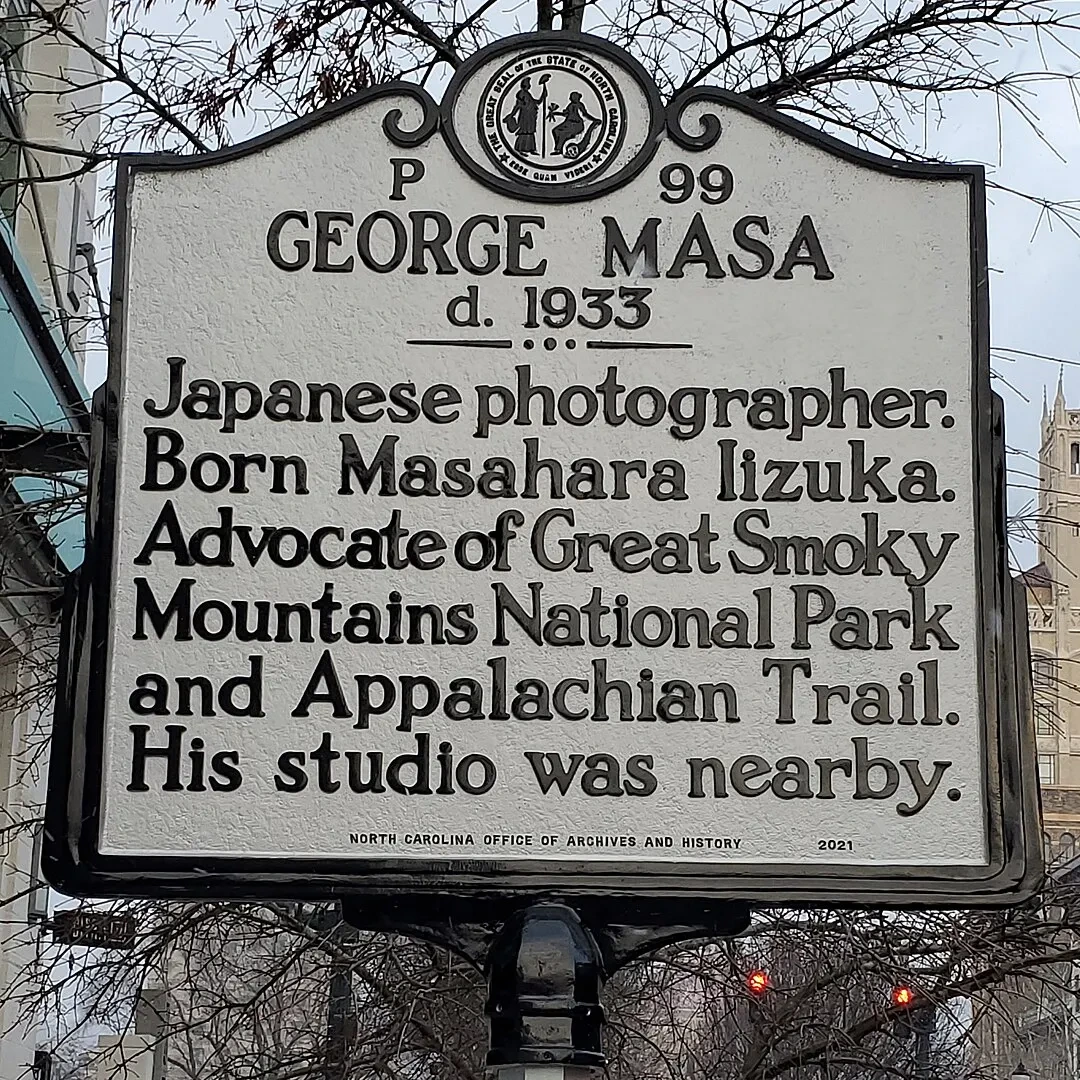
On April 8th, 2022, a standing Historical Marker was dedicated to George Masa in Asheville, North Carolina. The Marker is situated in Pack Square just off Patton Avenue in the area where Masa operated Plateau Studios.
Masa and his life might finally be gaining more mainstream acknowledgement, but the ultimate fate of his photographs is less certain.
Perhaps the true tragedy of George Masa’s story, and one that cannot be overlooked, lies in what happened to his massive collection of photographic negatives after his death. Masa’s estate, consisting primarily of his photographic equipment and his original negatives, was eventually sold at auction. From all accounts, his entire collection of negatives, consisting of as many as 6,000 images, were sold to another photographer, Elliot Lyman Fisher.
Fisher had arrived to Asheville, North Carolina in 1934, roughly one year following Masa’s death. Upon purchasing the Masa negatives, Fisher began distributing the photos to various publications as well as selling direct prints. It was stated that Fisher intended to preserve the negatives of George Masa.
Fisher is mentioned in several newspaper articles at the time, with at least one citing him as the owner of Masa’s negatives.
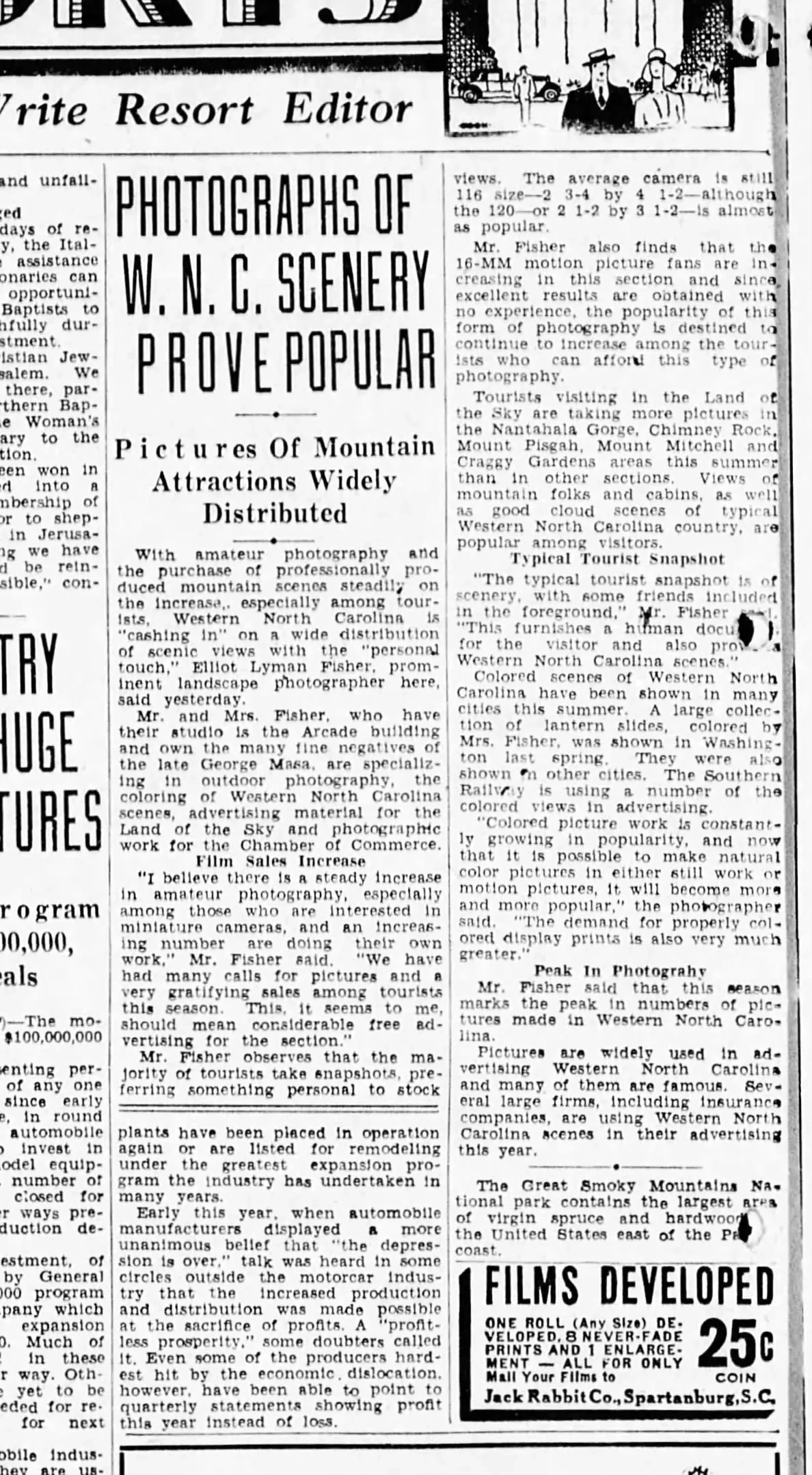
It is here where the useage, and final fate of Masa’s photographs becomes somewhat…interesting. Initially, Fisher published and sold materials printed from Masa’s negatives attributing credit to Masa. It’s unclear when, but at some point this attribution ceased, with Fisher beginning to use images shot by Masa as his own work. It’s worth noting that shortly after the acquisition of Masa’s negatives, Fisher began producing a large amount of photographs of the same areas Masa.
He (Fisher) was contracted by the Southern Railroad to provide promotional photographs of the areas within the section of the Appalachians the line would pass through — with many of those being the areas Masa had photographed previously.
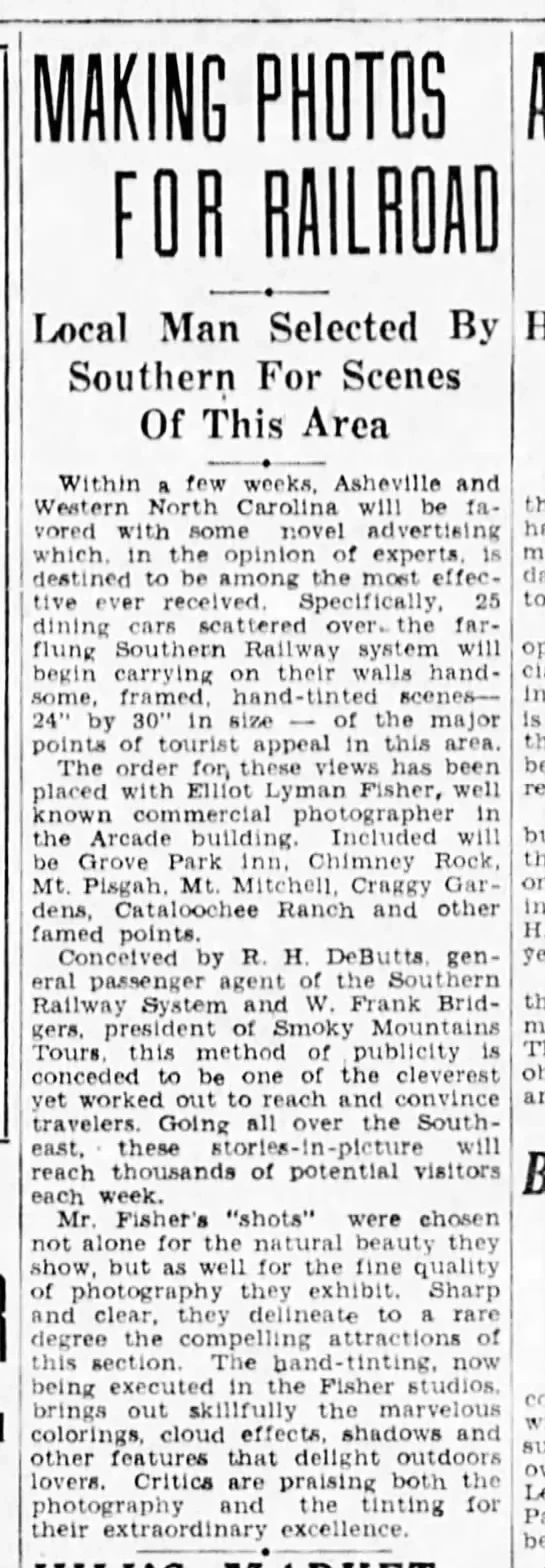
A person with a mildly cynical mind might draw parallels between the timing and locations of some of Fisher’s photographs and the ready availability of Masa’s negatives. This is not to suggest Fisher wasn’t a capable photographer in his own right. Records show he had been a working photographer for many years throughout the United States prior to his arrival in Asheville.
Elliot Lyman Fisher spent at least six years in Ketchikan, Alaska operating Fisher Studios from 1924 to 1930. The studio’s motto was “We photograph anything, Anywhere.” Fisher apparently even produced a book from his time in Alaska titled — perhaps redundantly considering his studio motto — We Photograph Anything, Anywhere. Aside from the original reference, I can find no record of this book physically in print.
While it’s true that Fisher did redistribute Masa’s photographs commercially, both credited and uncredited, the full extent of his usage remains unknown.
The ethicality of reproducing Masa’s photographs without credit is of course a matter of subjective opinion. What’s not up for debate is the fact Masa’s negatives would eventually vanish while in the possession of Fisher.
After leaving Asheville in 1958 for health reasons, Fisher and his wife Ella relocated to Florida. In 1961, Fisher passed away after battling a long illness, with at least one source stating he took his own life.
Even though he died in Port Charlotte, Fl, his death was still reported in the Asheville Citizen Times.
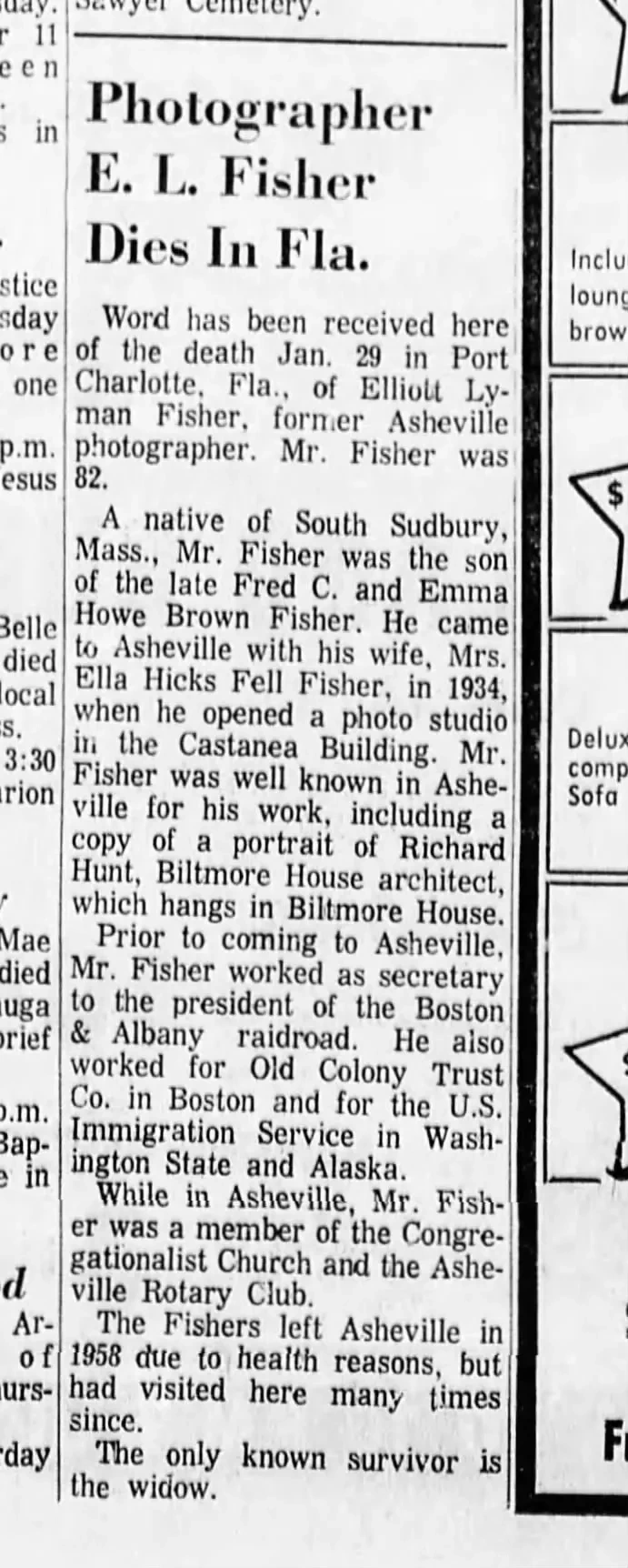
There is no mention of Fisher’s connection to the Masa photographic collection. Furthermore, there is no known record of Masa’s negatives ever passing from the possession of Fisher. Aside from his widow, no known children or relatives were mentioned who might have taken ownership of the Masa collection following Fisher’s passing.
Where are Masa’s lost negatives? Were they sold? Simply thrown away? It’s simply impossible to know. It could be that 6,000 photos from one of the most important photographers of the early 20th century are sitting in a basement attic just waiting to be rediscovered.
In death, in life, in work and in experiences, George Masa’s time on Earth was one of underlying mystery. As we approach the end of our story, it becomes necessary to bring into sharp relief a number of contradictions. In many ways, nearly a century after his passing, the memory of George Masa still walks hand in hand with the unknown.
Following the arrival of Masa in the United States, we noted that both the 1920 and 1930 U.S. census presented him as indeed being in the country. However, the reporting of the age and arrival dates between the two censuses…censi???…had changed significantly.
One census shows Masa arriving to the United States in 1914, with the other stating he arrived in 1906. His age also shifted by 16 years in the span of a decade.
These are not the only dates which seem to introduce conflicting information. A bit earlier in our story we mentioned a booklet by the Carolina Mountain Club published in 1993 commemorating the Club’s 70th anniversary. In that booklet, the date of Masa’s death is listed as July 7th, 1933. This is of course different from the June 21st, 1933 carved onto Masa’s gravestone, his death certificate, and also the telegram sent by Margaret Gooch on the presumed day of his death. The Carolina Mountain Club had paid for Masa’s funeral, and also later placed his grave marker in 1947.
Where did the July 7th date originate? Why is such an oddly specific (and contradicting) date on record for the death of Masa within the same organization who would presumably possess first-hand knowledge of the man so closely associated with the Club?
Masa’s claim that he attended Meiji University in Tokyo as a student of mining engineering is also curious. Meiji University has been an institution of learning since 1881, originally founded as a School of Law, and is still in operation at the time of this writing (2024).
The university has offered programs in business, mathematics, chemistry, law, and even electrical and mechanical engineering. However, at no time during the school’s 140 years of existence has it offered a curriculum in mining engineering or any similar field of study.
To add to these oddities, one of the most curious yet seldom mentioned things we have to consider about George Masa is: how did he learn photography?
It goes without saying that the operation of various cameras, lenses, and photographic gear can be a self-educated occupation. There are countless examples of people teaching themselves the craft, this author included.
However, when it comes to chemistry mixtures, film and plate development, wet printing, ect., it is HIGHLY unlikely that a person could essentially hit the ground running without some measure of outside instruction.
In Masa’s case, at the time he began working at the Grove Park Inn he was already developing film for himself and the patrons of the hotel. Not only was he processing the film, but doing so to such a degree of proficiency good enough to be recognized by those around him. This hints towards Masa already possessing a working knowledge of photography by the time he arrived in Asheville in 1915.
At least one person at the time, Fred Seely Sr. — Masa’s employer at Grove Park, specifically mentioned his (Masa) seemingly inexplicable photographic proficiency in a letter drafted to the United States Department of Justice.
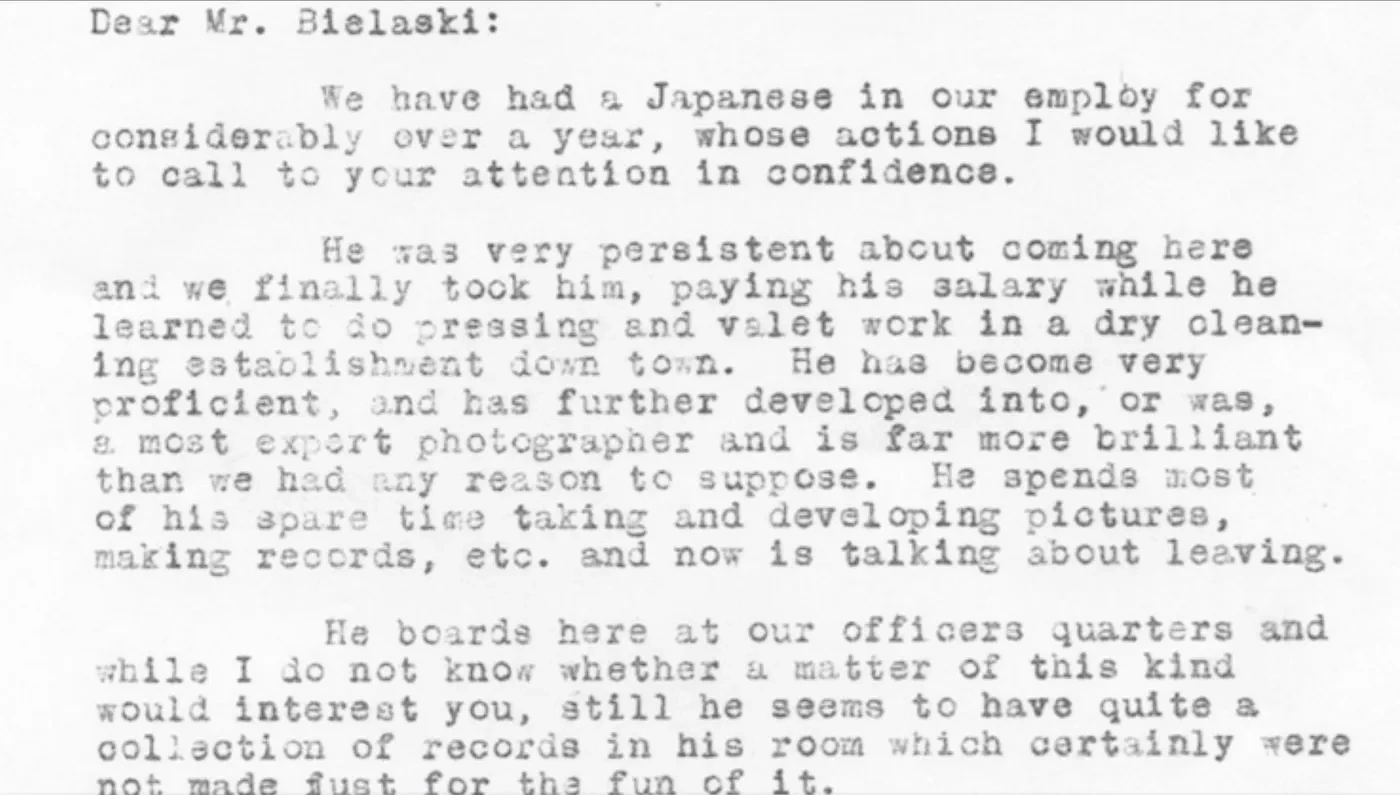
At the time he wrote the letter, Seely was head of the Asheville chapter of the American Protective League (APL), a civilian organization with ties to the U.S. Department of Justice. The APL was charged with identifying suspected German sympathizers and to counteract the activities of radicals, anarchists, anti-war activists, and left-wing labor and political organizations.
It seemed Seely had grown suspicious of Masa for various reasons, including but not limited to Masa’s keeping of detailed notebooks containing meticulous records of his activities in the United States, as well as his uncanny knowledge of photography.
Whatever Seely’s concerns might have been, they were apparently short lived. After sending the letter, Seely never again made any mention of nefarious activities connected to Masa.
With the confusion, contradictions, and cloudy history surrounding George Masa, perhaps the greatest mystery stems from his life in Japan. The records of his time in America aren’t numerus and we’ve seen repeatedly what little is available do not agree with one another — but at least we have something.
When it comes to Masa’s life before he immigrated to the U.S. there is virtually no information aside from what Masa himself had relayed to individuals along the way.
Or is there?
As more and more of Masa’s work in the Appalachians has reached mainstream recognition, more and more tantalizing evidence has emerged. Namely, clues to the connections of Masa’s family members in Japan. At some point in November, 1933, just months after his death, a CMC member sent copies of Masa’s obituary to a friend of the Club living in Japan. The letter and story of Masa then made its way to the Asahi Shimbun newspaper in Osaka who ran a story on Masa referring to the case as “the most moving international episode.”
In response to the story in the Asahi Shimbun a reader mailed a letter to the paper with the belief that George Masa could possibly be their long-lost brother — a brother not heard from in 25 years.
To add to this tantalizing account of Masa possibly having surviving family members in Japan, during the writing of this story, I stumbled across an obscure clipping from the September 3rd, 1933 edition of the Asheville Citizen Times.
In the ‘News of Other Days’ section it was said that ten years earlier on that same date (September 3rd, 1923) George Masa had expressed concern for the welfare of not only his brother, but also his sister following an earthquake.
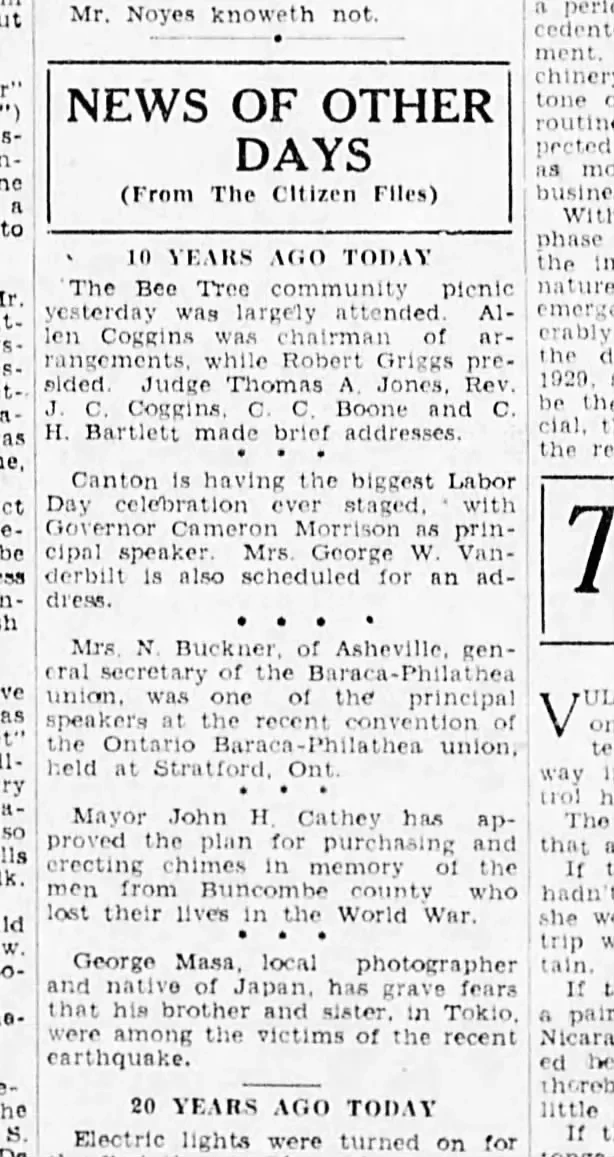
The Citizen Times article states that Masa himself said his brother and sister both resided in Tokyo (spelled Tokio in the article). Based on the year and location, it is virtually all but certain the “recent earthquake” was the Great Kanto Earthquake of 1923.
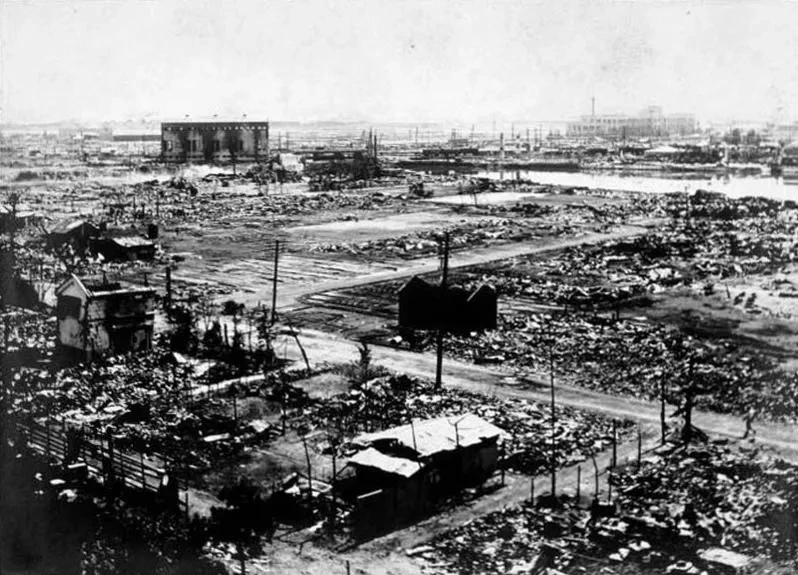
Estimated to have been a magnitude 8.3 on the Richter scale, the Kanto quake devastated Tokyo and Yokohama as well as surrounding areas throughout the Kanto region of Japan.
This all but confirms that Masa, by his own admittance, had no less than two living family members located in or quite close to Tokyo in 1923. Combining this information with the mention of the 1933 letter sent into the Asahi Shimbun newspaper from a man claiming to likely be Masa’s brother, one can assume that at least Masa’s brother survived the Kanto earthquake.
Even more intriguing, it could also imply that Masa had more than one brother. Taking into account that more than one source claim Masa’s reason for leaving Japan was due to the grief of his father’s death it is quite likely that the man known as George Masa — Masaharu Iizuka — could have living relatives still residing in Japan today.
Time has a way of washing away deeds, no matter how substantial. Through one cruel mechanization or another history tends to forget those who, in retrospect, should have been remembered the most.
Figures throughout humankind’s long past float away into the aether only to be recognized long after they themselves have finished the race. How many have we forgotten that will never be remembered?
Our world of photography is relatively close knit when compared to some other artistic mediums. The craft as we know it today was only developed in the early 19th century.
Even within this small corner of existence, we are beginning to see the resurgence of lost names whose works and legacies are just now coming into focus.
Names such as Vivian Maier, Bill Mortensen, Gerda Taro, Hippolyte Bayard, George Masa, and untold others, whether intentionally or not, were overshadowed, overlooked, forgotten — for at least a while.
Once only a name held high by a handful of photographers and local Appalachian families, Masa has become the subject of many books and popular documentaries in recent years. One such documentary, The Mystery of George Masa, produced and directed by Paul Bonesteel, is a wonderful investigation of the life of George Masa and was a source for much of the information found in this story.
I have learned that Bonesteel is preparing to release another documentary (as well as a book) on George Masa. A Life Reimagined: The Story of George Masa is scheduled for release in September, 2024. Both the documentary and accompanying book are said to present recently discovered information on Masa’s connection to Japan as well as fresh evidence of his arrival in America and his travels through the Pacific Northwest.
In a swing of universal irony, it turns out that time itself, the very mechanism responsible for wiping slates clean, ultimately reveals the value of things long since buried.
It seems that now, nearly a century after his death, George Masa’s time has finally arrived.
Author’s note
I feel it incumbent upon me to address potential attitudes towards some of the materials and information found within this story. The creation of the Great Smoky Mountains National Park displaced many generational families, and the attitudes towards this displacement varies wildly.
As a “son of the south” so to speak, I grew up in an area of west Tennessee where the Tennessee Valley Authority dammed and flooded rivers in order to construct hydroelectric power plants as part of President Franklin D. Roosevelt’s “New Deal Program.”
I am no stranger to the complexity of these issues, having lived them firsthand. I recall my grandparents speak of cemeteries and towns they knew which are now beneath a lake, and their opinions on the ethicality, reimbursement, and mode of relocations were relayed with differing perspectives.
As a personal favor, I request that any opinions on these matters as it relates to this story be expressed in a constructive manner, with a level of respect that would be shown to someone who you were conversing with face to face in a coffee house or bar.
To that end, it is also not lost on me the extent of near-cultural extermination of the native peoples who lived in the regions mentioned within this story, namely the peoples of the Cherokee Nation. There are facets of this issue which were related to Masa (and to some extent Kephart) and his contributions to the creation of GSMP that involved his association with the Cherokee which were omitted for the sake of relativity to this story.
For the same reason, the host of people and organizations involved over the decades to establish a National Park in the southern Appalachian Mountains are simply too numerous to contain within a story on Medium which has already bloomed far beyond the margins of its original scope.
Again, I ask that any comments relating to the political, cultural, or otherwise contentious topics relating to this story to be voiced politely and with humanistic respect to other readers.
Citations and References
1923 Great Kantō earthquake (2024) Wikipedia. Available at: https://en.wikipedia.org/wiki/1923_Great_Kant%C5%8D_earthquake (Accessed: 26 April 2024).
Admin (no date) An eye for mountains: An Ansel Adams of the Smokies, George Masa was one of the greatest photographers of his era. so why have so many people never heard of him?, Smoky Mountain News. Available at: https://smokymountainnews.com/archives/item/1839-an-eye-for-mountains- an-ansel-adams-of-the-smokies-george-masa-was-one-of-the-greatest- photographers-of-his-era-so-why-have-so-many-people-never-heard-of-him (Accessed: 26 April 2024).
American Protective League (2024) Wikipedia. Available at: https://en.wikipedia.org/wiki/American_Protective_League (Accessed: 26 April 2024).
Archives West Finding Aid (no date) Early photographers collection — Archives West. Available at: https://archiveswest.orbiscascade.org/ark:80444/xv52062#idm4256 (Accessed: 26 April 2024).
Decker, S.J. (2022) Coming into focus: George Masa’s legacy: Appalachian trail conservancy, Appalachian Trail Conservancy |. Available at: https://appalachiantrail.org/official-blog/coming-into-focus-george-masas- legacy/ (Accessed: 26 April 2024).
George Masa Photograph collection (no date) Highlands Historical Society. Available at: https://www.highlandshistory.com/exhibits/masa-photographs (Accessed: 26 April 2024).
George Masa: Less talk, more walk — david huff (2024) YouTube. Available at: https://youtu.be/vdTJKCpnhb0?si=iPTDDoC0X4bjgGFo (Accessed: 26 April 2024).
Hazel Creek (great smoky mountains) (2023) Wikipedia. Available at: https://en.wikipedia.org/wiki/Hazel_Creek_(Great_Smoky_Mountains) (Accessed: 26 April 2024).
Magazine, O.H. (2022) Kephart: O.Henry Magazine, OHenry Magazine. Available at: https://ohenrymag.com/kephart/ (Accessed: 26 April 2024).
Mountaineers and Rangers: A History of Federal Forest Management in the Southern Appalachians, 1900–81 Chapter 1 Conservation Movement Comes to the Southern Mountains (no date) Npshistory.com. Available at: http://npshistory.com/publications/usfs/region/8/history/chap1.htm (Accessed: 26 April 2024).
The Mystery of George Masa (no date). United States: PBS. Available at: https://www.pbs.org/video/the-mystery-of-george-masa-vpupue/.
The mystique of George Masa (2020) YouTube. Available at: https://youtu.be/dkIFHMcC3dM?si=f6Q00yyrC8efIz6n (Accessed: 26 April 2024).
Priestley, K. (2009) Light and shadow: The mystery and legacy of George Masa, Mountain Xpress. Available at: https://mountainx.com/arts/art- news/082609light_and_shadow/ (Accessed: 26 April 2024).
The weeks act of 1911 (no date) Museum of the White Mountains. Available at: https://www.plymouth.edu/mwm/the-weeks-act-of-1911/ (Accessed: 26 April 2024).
Buying through these links helps keep this site running. As an Amazon Associate I earn from qualifying purchases.
Text © 2024 Adam Welch. Historical images and source credits as indicated.